Why old poly can feel harsher even as its tension falls
Tension is down, but the response feels worse. Those observations can coexist—and neither needs to be dismissed as imagination.

An awkward contradiction appears late in the life of some polyester setups. The tension reading has fallen, yet the response feels less forgiving. A routine forehand sometimes sails; a hurried return feels abrupt and unresponsive. You tell the stringer that the strings have become both too loose and too stiff. It sounds inconsistent only if tension is expected to describe everything happening in the stringbed.
For a player who has learned to trust a particular launch window, the problem is more specific than losing the pleasant sensation of fresh strings. You begin changing the swing to find the old trajectory. You close the face to contain one ball, then accelerate harder because the next feels short. Before blaming your timing, it helps to separate the different ways strings can change.
The stringbed yields in more than one direction
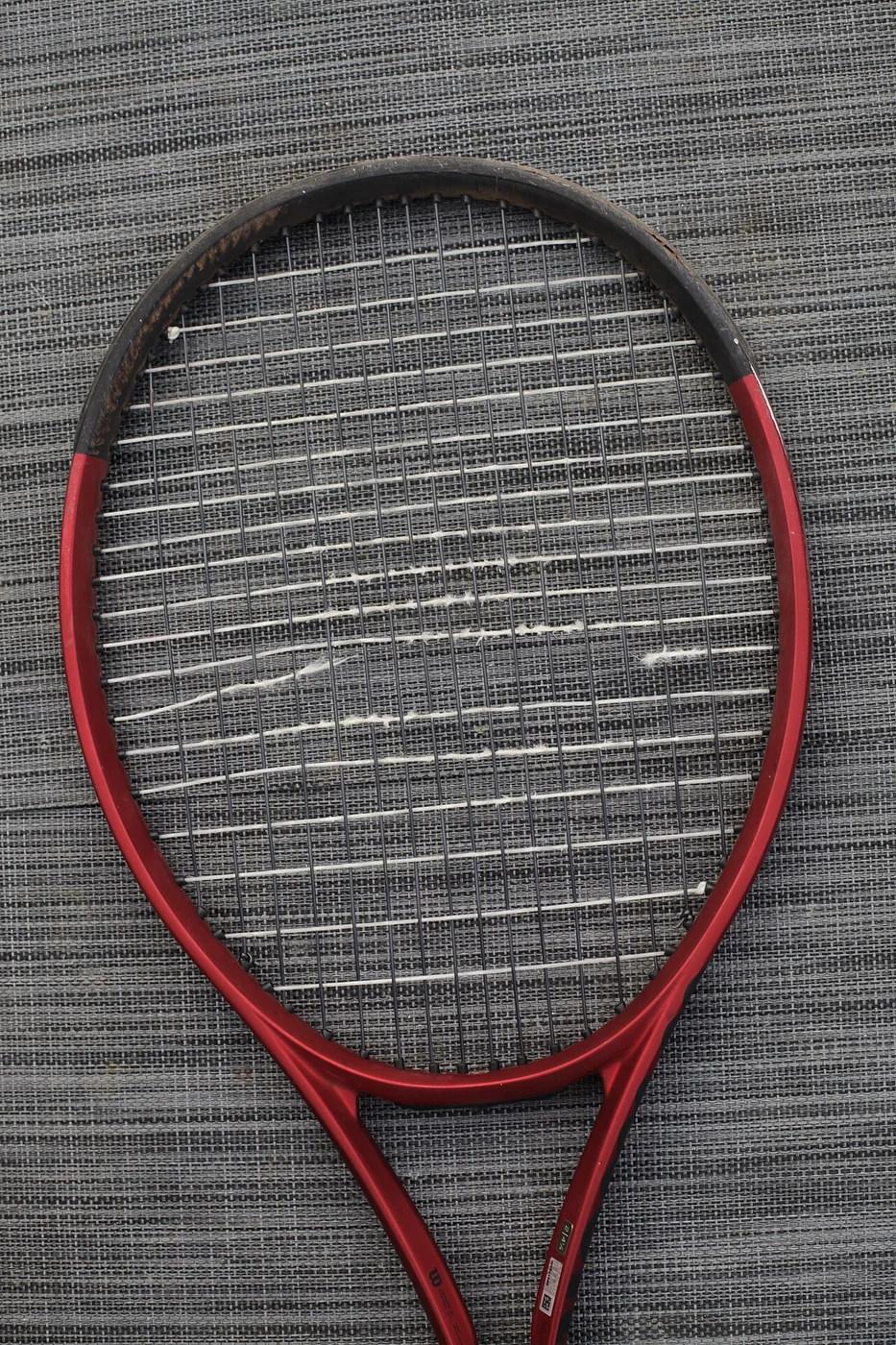
When the ball presses into the racquet, the stringbed deflects out of its plane. During an oblique impact, the main strings can also move sideways across the crosses. Resistance to the first movement and freedom to make the second are related, but they are not interchangeable. A bed can become easier to push backwards while its intersections become harder to slide across.
That distinction is central to Crawford Lindsey’s March 21, 2013 Tennis Warehouse University study, How Tennis Strings Go Dead—Part 1. Repeated-use experiments examined tension, stiffness, force, energy return, dwell time and inter-string friction. The proposed explanation for the apparently contradictory complaints combined decreasing perpendicular stiffness with increasing resistance to lateral string movement. These are historical laboratory findings, not a lifespan certificate for every current polyester.
Lower perpendicular stiffness can allow more stringbed deflection and longer contact. In a moving racquet, changes in contact duration and response can alter the outgoing trajectory. Meanwhile, greater friction at string intersections can inhibit the movement and return of the mains. The resulting experience need not fit neatly into either ‘softer’ or ‘harder’. Both words may be describing different parts of the same collision.
Even here, the effects do not simply add up in one direction. Lower tension can also reduce the force pressing intersecting strings together, which can favour movement. Wear may oppose that benefit. Material, pattern, tension and contact conditions determine the balance. This is why a rule such as ‘poly becomes harsh after exactly eight hours’ promises more precision than the evidence provides.
Dead does not mean the string has stopped returning energy
A second misunderstanding is that a dead string has somehow used up its elasticity and now absorbs most of the ball’s energy. Lindsey’s follow-up, published on April 17, 2013, found a more complicated picture. Repeated impacts and tension changes affected deformation, contact time and energy return, but the tested string still returned substantial energy. The paper also showed that previous stretching changed the subsequent response.
That does not make your loss of confidence imaginary. A useful tennis response is more than an energy-return percentage. If the launch direction changes, or lateral movement becomes less effective, you can lose the ball flight you rely on without a dramatic reduction in rebound speed. Compensating with a harder swing then changes the collision again. The familiar complaint ‘I have to work harder, but the ball still goes long’ is worth investigating rather than correcting on vocabulary alone.
TWU’s September 7, 2021 study of energy flow between a ball and stringbed reinforces the need to separate speed from sensation. In its semi-dynamic experiment, differences in string material and tension produced relatively small changes in rebound energy compared with changes in some feel-related parameters. That experiment was not a worn-poly playtest. Its relevance is narrower: a powerful or dead sensation cannot, by itself, establish how fast the ball left.
Look for a change in the shot you can repeat
The practical question is whether the current setup still gives you a predictable result for a familiar input. Choose a ball you can produce without chasing maximum pace: for example, a balanced crosscourt forehand towards a generous target. Observe the height over the net, where it lands and how often you must interrupt your normal swing. Do the same with a compact return or volley. Different impacts can reveal different complaints.
Keep the comparison fair enough to be useful. A new can of balls, a colder evening or a rushed warm-up can change the result before the stringbed becomes the main suspect. If you have a second racquet, its frame specifications and string setup should be reasonably comparable. Switching to an entirely different racquet may restore confidence, but it does not isolate the cause.
| What has changed | What it can tell you—and what it cannot |
|---|---|
| Tension is lower than the established baseline | The measured state has changed. The number alone does not reveal friction, spin output or remaining usable hours. |
| The mains stay displaced after a shot | Their movement and return deserve attention. Resting alignment does not measure what happened while the ball was still touching them. |
| Routine balls now launch higher or scatter in depth | There may be a repeatability problem. Compare similar balls, conditions and contact before assigning it to string wear. |
| A fresh, comparable setup restores the expected response | That supports an equipment explanation for this player and setup. It does not prove a universal replacement interval. |
A gentle manual check of string movement can add context, especially if you remember how the fresh setup behaved. It is not a spin test. TWU’s January 30, 2011 high-speed work on snap-back observed rapid lateral movement during impact, considerable variation between impacts and local stretching even when movement was not visibly obvious. Your fingers cannot reproduce that event, and neatly aligned strings are not proof of unchanged performance.
Use tension as a history, not a verdict
A useful record needs surprisingly little information: the exact string and gauge, the racquet, the work date, a consistent post-stringing reading, playing time and brief notes on response. Keep the early settling period visible. Compare later readings with the same reference point rather than switching between the requested machine tension and a measurement taken after the first session.
Over several string jobs, a pattern may emerge. Perhaps your preferred response disappears before visible damage becomes dramatic. Perhaps the largest tension drop happens early, followed by several satisfactory sessions. Either is more useful than borrowing another player’s percentage threshold. Treat the pattern as a personal decision aid: a change of gauge, stringer, frame or playing conditions can make the old interval less applicable.
Do not turn this into an obligation to keep using an unpleasant setup until a graph grants permission. The purpose of the record is to make the next choice clearer. Persistent discomfort also deserves attention on its own terms; a tension reading cannot identify its cause or establish that continued play is appropriate.
The next string job should answer one question
If you liked the setup when fresh, repeating it once with better records is often a more informative experiment than changing the string, gauge and reference tension together. You can then distinguish dissatisfaction with the original response from dissatisfaction with how it ages. Those lead to different choices: a different starting setup in the first case, or a different replacement schedule or material in the second.
If the original response was already too demanding, lowering the starting tension is one possible adjustment, but it is not a guaranteed cure for later friction changes. Equally, increasing tension to contain a worn bed does not establish what a fresh bed needs. Make the next decision from the state you want to reproduce, not from an emergency compensation made during the last bad session.
The useful end of this investigation is a sentence more precise than ‘the poly died’: ‘My normal forehand started launching higher, the compact return became less predictable, and the change persisted under comparable conditions.’ Add the tension history and you have something a stringer can work with. A lower reading and a harsher sensation can coexist. What matters is learning when that combination stops serving your game.
Sources and further reading
TENNIS TENSION LAB
Check your racquet’s tension today.
Get a high-precision tension reading in under 10 seconds. Tension Lab tracks changes from your first reading and helps you see when to restring.
- High-precision tension measurement. Ready in under 10 seconds.
- Track every change in feel. See the full story over time.
- Time to restring? Never leave it to guesswork.