The tennis shoe with the most grip is not automatically your best shoe
Stopping without an unwanted slip is essential. That does not mean every increase in grip improves every movement that follows.
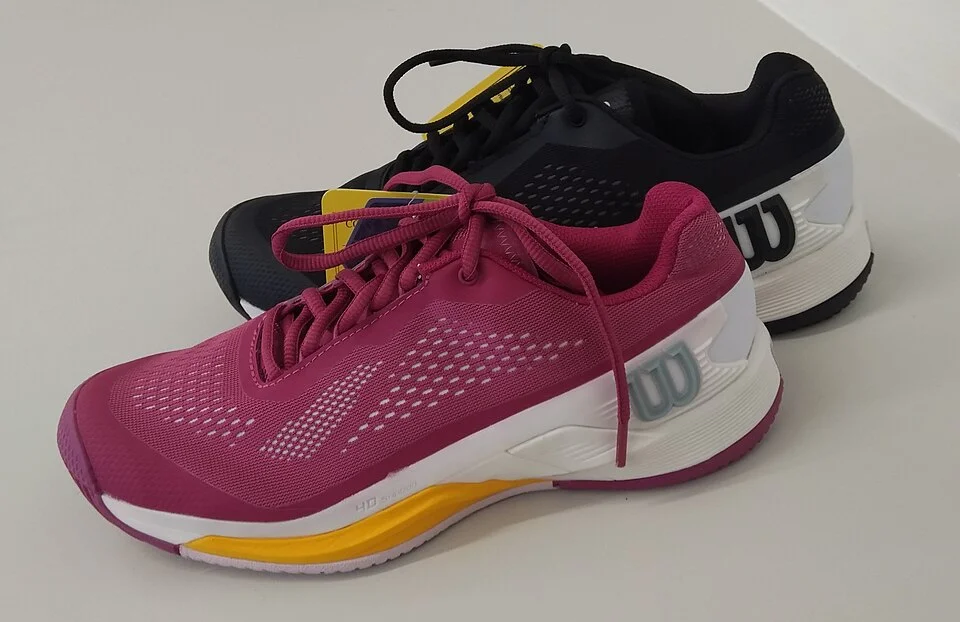
Grip is an unusually persuasive word when you shop for tennis shoes. You remember the ball you reached but could not control because your foot slipped. A promise of more grip seems to offer an obvious improvement: less movement underfoot, more certainty above it. The difficulty is that a tennis point does not end when the shoe stops. You still have to turn, organise the next step and leave the position you have just secured.
There are therefore two questions hiding inside “does it grip well?” One concerns the traction available between a particular outsole and court. The other concerns what your movement actually requires and uses. Treating them as the same question encourages an equipment ranking in which the highest number must win. A 2016 Tennis Warehouse University pilot study is useful precisely because it separates them.
Crawford Lindsey’s project, published in November and edited in December 2016, developed a rig to investigate translational and rotational traction. Translational traction resists sliding across the surface. Rotational traction resists turning at the contact. Both belong to tennis, but they are not interchangeable descriptions of “stickiness.” A shoe can be discussed in terms of resistance to a straight movement without that measurement fully describing a turn.
Read the experiment before ranking the coefficient
The rig used a forefoot section cut from a right Asics Gel Resolution 6 in US men’s size 9. It pressed that section against an acrylic court surface prepared by DecoTurf, then applied controlled forces through a pendulum arrangement. A separate configuration allowed the surface to rotate under the forefoot. This was a study of a test method and the forces influencing the interface, not a tournament between current retail shoes.
For straight-line traction, the coefficient is the horizontal traction force divided by the normal force pressing the shoe and surface together. The peak value before sliding describes available static traction under those conditions. A player may use less than the available amount to complete a movement. The study distinguishes that utilised traction from the maximum the interface can supply. More capacity does not establish that the player needs, uses or benefits from every part of it.
Even the coefficient needs its test conditions. In the pilot, peak traction force increased with normal force, but the coefficient decreased as normal force rose. That is not a contradiction: a ratio can fall when its denominator grows faster than its numerator. Loading rate also influenced the result. Copying a single coefficient into a shoe review while dropping the loads and timing removes information necessary to interpret it.
There was another subtlety. Some movement recorded by the apparatus came from the shoe material deforming sideways, rather than from the outsole sliding across the court. The researchers used the movement and recovery to distinguish those contributions. A sensation of movement does not always identify one mechanism. On a real foot, movement inside the shoe adds yet another practical question that this cut-section rig was not designed to settle.
The author was explicit about limits. Some normal forces were lower and horizontal forces higher than values previously reported for tennis movements. Force rose to its peak over a much shorter interval than in the cited running-forehand measurement. The study’s conclusion said that research was insufficient to make scientifically established choices for the best combination of performance and injury reduction on a given surface. Those qualifications belong with the findings, not in a footnote that disappears when the numbers become a ranking.
The paper discusses proposed traction ranges from other research and the possibility of having more available grip than a movement needs. It does not give a universal safe coefficient for your shoe, court and body. Nor is it a reason to modify the outsole to make it slide. A materials result cannot by itself tell a player to copy an elite hard-court slide, or prove that a lower-grip shoe prevents an injury.
A more useful shoe note than “very grippy”
For an experienced player, the practical gain is a better description of the problem. An unwanted slip on push-off, a foot moving inside the upper and an unexpectedly abrupt stop can all end with “I didn’t trust the shoe.” They call for different questions. Start by identifying the event, the court condition and the direction of travel. Do not immediately turn every uncertain step into a verdict about the rubber compound.
| What you noticed | What to record next |
|---|---|
| The outsole slipped when you expected it to hold | Court location and condition, direction, outsole wear or visible contamination |
| The foot moved but the outsole seemed planted | Where the foot moved inside the shoe, fit and fastening at the time |
| Stopping felt predictable but the following turn felt awkward | The sequence of steps and direction change, rather than one overall grip score |
| The same shoe behaved differently at another venue | Surface and conditions at both venues; avoid assuming the shoe changed |
| Confidence changed late in the session | Timing, fatigue and any changes in court or footwear condition |
None of these observations measures a coefficient. Their purpose is to make a conversation with a coach, fitter or retailer more specific. If the foot is moving inside the shoe, asking only for a stickier outsole may miss the issue. If the same pair loses predictability in one patch of court, the surface deserves attention before the entire model is condemned. A worn shoe and a new shoe are not identical specimens simply because the model name matches.
When comparing shoes, begin with fit and suitability for the surface you actually use. Keep the comparison within familiar movements during a normal warm-up, building intensity in your usual controlled way. There is no need to discover the slip threshold by forcing a sudden cut or attempted slide. An unexpected loss of traction or catching sensation is information to stop and investigate, not an invitation to repeat it harder until the shoe passes.
Conditions matter to the comparison as much as the label on the box. A clean, dry acrylic court and a court carrying moisture or debris are not the same interface. Neither are the shoes at the beginning and end of a long period of outsole wear. Record the conditions you actually experienced. A confident impression from one venue remains useful, but it should travel to another venue as a question to revisit, not a guarantee.
There is a temptation to substitute sound for that record: a loud squeak feels like strong grip. Sound alone supplies neither the normal force nor the horizontal force needed to calculate the coefficient. It also does not describe how your next turn felt. What matters to the player is a predictable sequence of contact, deceleration and recovery in the intended setting, not winning a contest for the most convincing noise.
This older, retailer-affiliated pilot does not identify a shoe you should buy today. It helps remove an unreliable shortcut from the buying decision. You need sufficient, dependable traction for your movements on your court, alongside fit and support that let you use it. The next time someone describes a tennis shoe as having enormous grip, the revealing follow-up is where, under what conditions and during which movement. That turns a superlative into information.
Sources and further reading
TENNIS TENSION LAB
Check your racquet’s tension today.
Get a high-precision tension reading in under 10 seconds. Tension Lab tracks changes from your first reading and helps you see when to restring.
- High-precision tension measurement. Ready in under 10 seconds.
- Track every change in feel. See the full story over time.
- Time to restring? Never leave it to guesswork.