Both racquets say 305 g. Why does one keep arriving late?
The scale counts how much material you lift. Your swing also has to move that material around an axis. Where the grams sit can matter as much as their total.

The shopping filter says 305 g, so the shortlist looks tidy. Then the demo begins. One frame gets through a compact return comfortably; the other seems to ask for an earlier start. From a full baseline swing, the second may feel reassuring instead. Before blaming an inconsistent arm or declaring one specification sheet wrong, open another column: swingweight.
The 305 g figure in this example is a hypothetical listing, not a comparison of named products. It can describe a useful part of a racquet without describing the movement that interests you. Mass tells you how much material there is. Balance locates its centre of mass. Swingweight describes resistance to rotation about a specified axis. Reading only the first is rather like comparing two routes by their distance while ignoring the bends.
Three measurements, three different questions
Tennis Warehouse University's explanation of weight, balance and swingweight separates the experiences players often put into one word: heavy. Lifting a racquet at its balance point gives a relatively direct impression of its overall mass. Holding it horizontally by the handle introduces leverage. Starting or changing its rotation asks a different question again. A frame can feel one way when held still and another when you ask it to turn.
Balance is the point where the racquet rests level on a narrow support. For frames of the same length, moving that point toward the handle makes the balance more head-light. At equal mass, that reduces the torque required to hold the racquet horizontally from the handle. It does not specify how all the material is distributed on either side of the balance point. Two racquets can share a centre of mass while placing different amounts nearer the ends.
Swingweight captures that missing feature for a particular rotation. The distance of each piece of mass from the axis matters squared. Material well away from the axis contributes disproportionately. Consequently, equal mass and even equal balance need not produce equal swingweight. These measurements complement one another; balance is not a shortcut for calculating the complete distribution.
| Placement from the butt | Distance from the measurement axis | Increase in swingweight |
|---|---|---|
| 20 cm | 10 cm | 0.005 × 10² = 0.5 kg·cm² |
| 60 cm | 50 cm | 0.005 × 50² = 12.5 kg·cm² |
The second placement adds 25 times as much rotational inertia about that axis, despite adding exactly the same mass. That is a comparison of the additions, not a claim that the completed racquet becomes 25 times harder to swing. Its existing swingweight remains part of the total. The calculation, using the added-mass relationship discussed in TWU's customization research, explains why asking only “how many grams?” leaves out the most consequential part of many adjustments.
The conventional measurement axis is 10 cm from the butt. Your entire stroke does not rotate around a hinge fixed there: arm segments and the racquet move together, and the relevant axes change through the action. The standard gives a consistent comparison between racquets. Keep the axis and units the same when comparing published numbers, and do not treat one familiar number as a complete simulation of your serve.
More resistance can help at contact and cost before it
Rotational resistance works in both directions. The player applies force to accelerate the racquet; the arriving ball also applies force and changes its motion. A frame that resists your effort to start it can also resist the ball's effort to push it back. That tradeoff helps explain why a racquet may feel demanding in a hurried preparation yet satisfying through a well-prepared contact.
Crawford Lindsey's 2014 TWU customization experiment examined this with a double pendulum. A falling mass supplied the same input energy while mass was added at different positions on the racquet section. The main apparatus used a wooden beam rather than a normal strung frame, and additions ranged from 20 to 200 g to make the effects clearly observable. It was a mechanical study, not a test of players adapting to ordinary small modifications.
Within that setup, adding mass anywhere reduced racquet speed at the fixed energy input. Outgoing ball speed had a more complicated relationship: it could rise at lower swingweights, reach a peak and then decline. The extra contribution at collision did not keep compensating indefinitely for lost racquet speed. A player who supplies more energy changes the comparison, which is why those results should not become a promise of an exact speed change for your next strip of weight.
For a demo, the useful consequence is to include more than the stroke that makes the candidate shine. A full rally swing gives you preparation time. A compact return, an adjustment volley or a late defensive ball asks for a different response. Observe whether the additional solidity is still useful when the preparation is shortened. There is no need to announce a universal swingweight ceiling from one player's good or bad session.
First make sure the two numbers describe the same thing
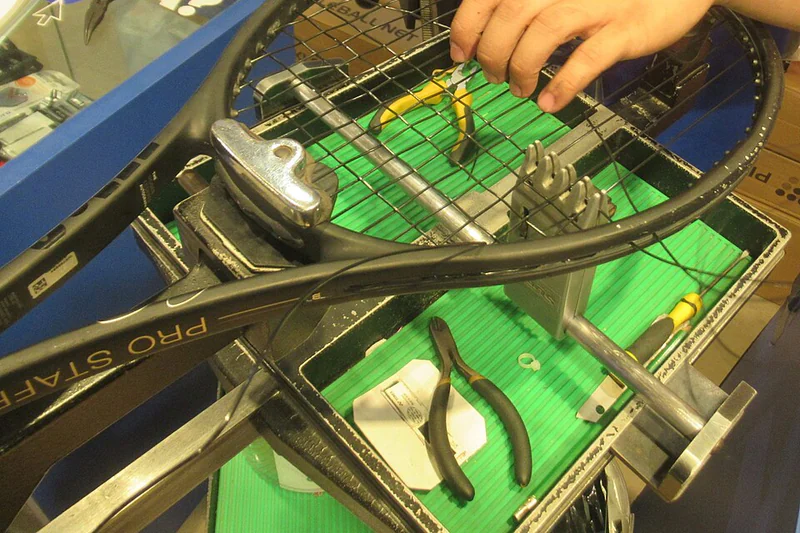
Before interpreting a difference in feel, check the state of each racquet. Is 305 g the advertised unstrung mass, a retailer's strung measurement or what your own scale reads today? Are the grips and accessories the same? A string installation adds material throughout the head; an overgrip puts it near the handle. Their contributions to mass, balance and swingweight are not interchangeable simply because both appear on the scale.
A useful record keeps the frame identity and measured ready-to-play mass, balance and swingweight together, alongside the string model, gauge, tension request, grip and accessories. Keep units and measurement method with the numbers. If a shop measures the racquet for you, ask whether its values refer to that exact example in its current setup or a reference specification for the model. Those answer different purchasing questions.
String tension belongs in the record for a separate reason. Two demos with different stringbeds can produce different launch, feel and depth responses, which complicates attributing everything you notice to mass distribution. A tension history helps describe that part of the setup. It does not measure swingweight, and an acoustic tension reading cannot reconstruct how the frame's mass is distributed.
A second racquet needs more than a matching scale reading
This becomes especially relevant when buying a backup. If the first racquet works well, the goal is a usable replacement during a match. Adding enough material to make the second show the same mass is only one step toward that goal. Record both examples before changing them. A gram target reached at the wrong location can leave a different balance or rotational response.
For an initial court comparison, alternate short blocks rather than using one frame only while fresh and the other after fatigue has accumulated. Include the return and serve as well as baseline hitting. Note the specific task that changes: getting the face ready, maintaining a planned contact, resisting a heavy incoming ball, or controlling depth. “Feels heavy” hides several different observations that can point to different adjustments.
Matching the three measurements still does not make two different racquet designs identical. Length, geometry, string pattern and structural behaviour remain relevant. The point is to remove a misleading assumption from the choice, not replace it with a claim that one more number explains everything. Use measurements to understand the candidates, then judge the complete setup in the situations you actually need.
When the next shortlist says 305 g beside every name, leave it open. Add the measurement state, balance and swingweight before deciding that the options must be equally manageable. The scale has answered its question accurately. You were asking it a second question it cannot answer alone.
Sources and further reading
TENNIS TENSION LAB
Check your racquet’s tension today.
Get a high-precision tension reading in under 10 seconds. Tension Lab tracks changes from your first reading and helps you see when to restring.
- High-precision tension measurement. Ready in under 10 seconds.
- Track every change in feel. See the full story over time.
- Time to restring? Never leave it to guesswork.