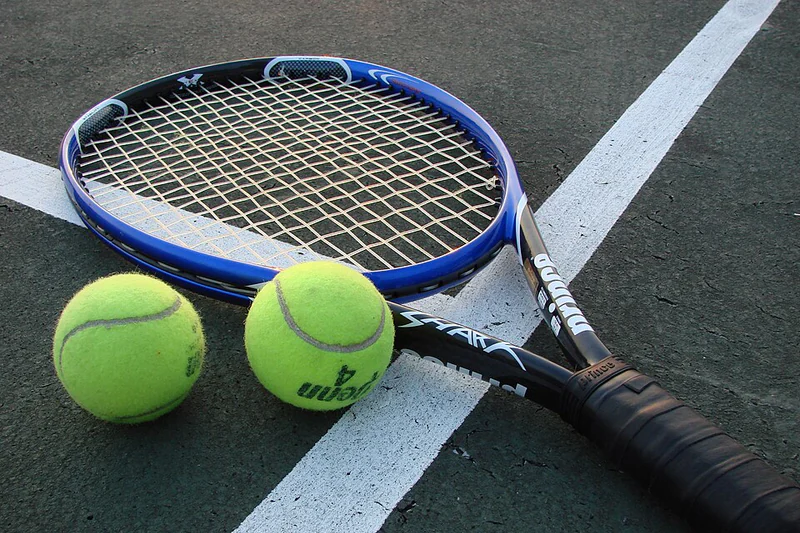
12 o’clock or 3 and 9? The same four grams can change a racquet in different ways
A firmer response on a mishit and an easier swing are different requests. Decide which one you are making before moving the tape.
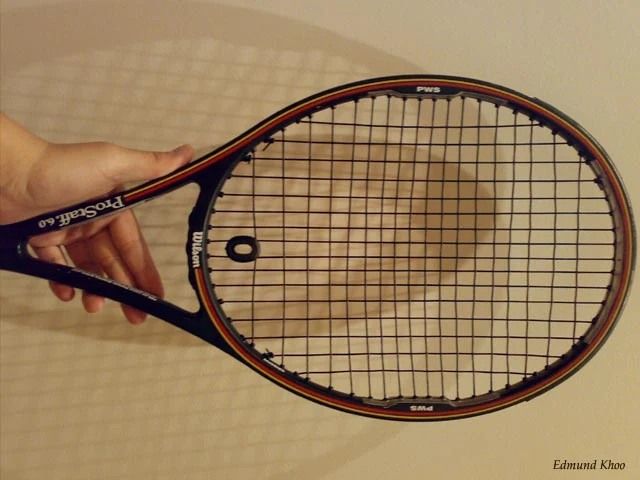
“It needs a little more stability.” That sounds like a precise request until you ask what happened on the last difficult ball. Did the face turn when contact drifted toward the side of the stringbed? Did the whole racquet seem to recoil against a heavy shot? Or was the head simply late arriving? Those experiences can travel under the same word, but they do not ask for the same adjustment.
The choice between putting tape at 12 o’clock and splitting it between 3 and 9 is useful because it exposes that ambiguity. Both arrangements add mass to the head. Neither is free to swing. Yet a gram farther from the handle and a gram farther from the racquet’s long centreline have different jobs. There is no universally better position until you identify the rotation you want to resist.
Picture two hinges, not one “heavy” racquet
Hold the racquet upright in your imagination, handle down. Twelve is the tip; three and nine are the sides of the hoop. Now picture the head swinging forward about a transverse axis near the handle. Moving added mass toward the tip places it farther from that axis, increasing its contribution to the measured swingweight. The familiar specification describes resistance to that rotation, using a standard measurement axis rather than reproducing every moving joint in your stroke.
The second hinge runs lengthwise, from handle through the centre of the head. A ball struck to one side can twist the face about this long axis. Twistweight is the moment of inertia about it. Mass at the sides sits farther from that line than mass concentrated at the centre of the tip. That is why the same total addition can resist this twisting motion differently even when both setups feel heavier.
This does not mean tape at 12 contributes no stability, or that 3-and-9 weighting leaves swingweight alone. The first also changes mass and the racquet’s response to impact. The second is still well above the handle and increases swingweight too. The distinction is relative: which property does a particular placement change most efficiently for the amount you add?
A four-gram example, with the assumptions visible
Consider an illustrative racquet and idealise each piece of added material as a point mass. Use the common swingweight reference axis 10 cm from the butt. Put 4 g at a tip position 68.5 cm from the butt, or split the same total into 2 g on each side at a longitudinal position of 53 cm, each 12 cm from the long centreline. These are chosen dimensions for arithmetic, not measured specifications of the photographed racquets or a prescription for yours.
For added inertia about a fixed axis, the contribution is mass multiplied by the square of its perpendicular distance from that axis. Using kilograms and centimetres gives kg·cm². For the forward-swing reference axis in this simplified flat geometry, the tip contribution is 0.004 × 58.5² = 13.69. The combined side contribution is 0.004 × 43² = 7.40. For twisting about the long centreline, the side pair contributes 0.004 × 12² = 0.576.
| Placement of the same 4 g | Added swingweight, kg·cm² | Added twistweight, kg·cm² |
|---|---|---|
| All at 12, on the long centreline | 13.69 | 0 in this idealised geometry |
| 2 g at 3 and 2 g at 9, at the stated positions | 7.40 | 0.576 |
Real tape has length, width and thickness, so the zero in the first row is an idealisation, not a laboratory promise. Its actual mass is distributed rather than concentrated exactly on the centreline. Likewise, a different hoop shape or a strip extending farther around the head changes the distances. The example explains why location matters; it cannot tell you that one layout will produce a particular ball speed or a particular percentage improvement in control.
What an actual off-centre impact experiment adds
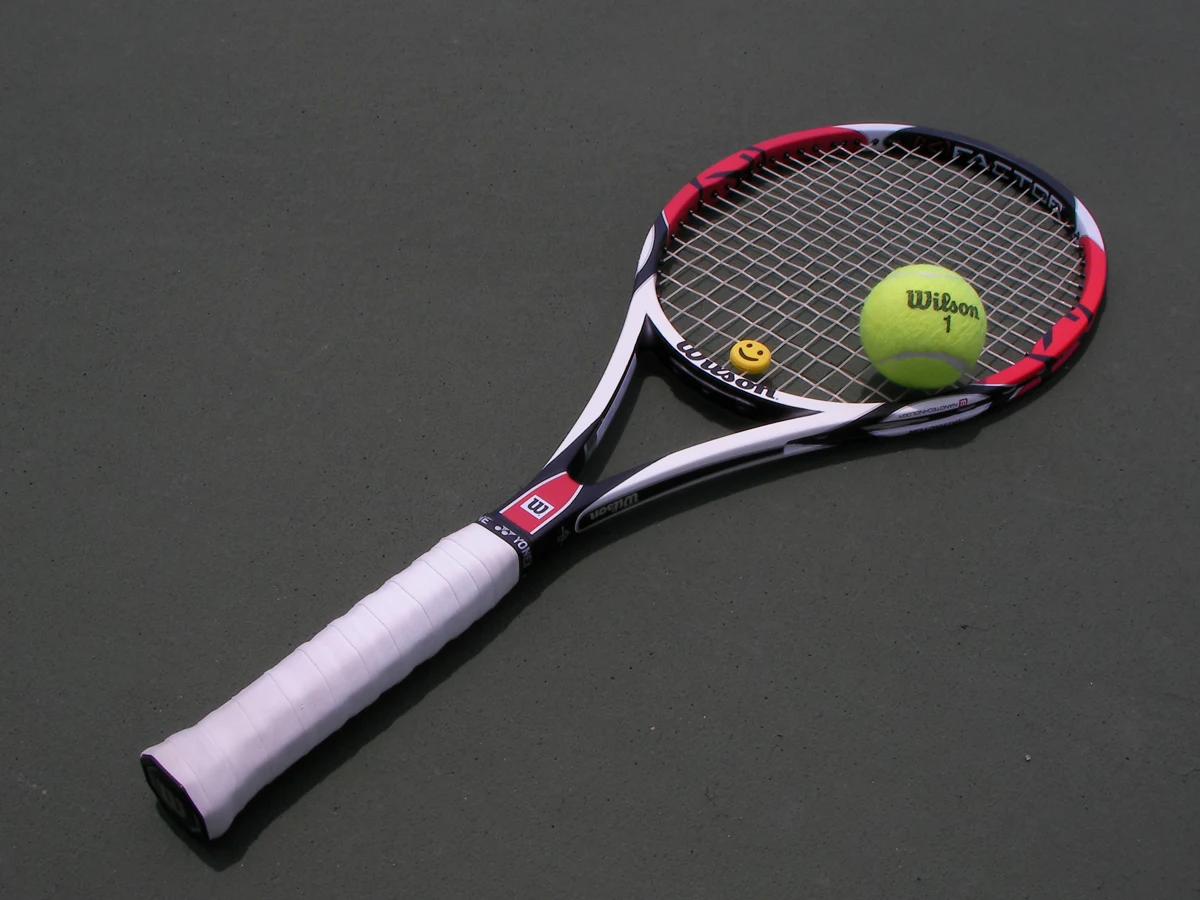
In their 2019 Tennis Warehouse University study, Rod Cross and Crawford Lindsey fired balls at a hand-held racquet that was initially stationary, with its tip resting lightly on the floor. They varied the incoming conditions and moved the impact across the stringbed at the same height. After a wider set of trials, their published analysis concentrated on 165 shots with one racquet, comparing it with and without two bolts at 3 and 9.
The scale of that intervention matters: each bolt weighed 13.4 g, for a 26.8 g addition to a 291 g racquet. That is substantially more than the illustrative four-gram adjustment above. Adding the bolts increased rebound performance, and the authors related the response to the effective mass at the impact location. Their explanation connects higher effective hitting mass with less twisting, rotation and translation during impact.
It would be a mistake to turn that result into “two grams here will fix your return.” The study did not have players swing customised racquets in matches. It deliberately removed the swing to isolate impact behaviour, and the incoming angle and spin still mattered greatly. The authors explicitly returned to the importance of the player’s swing and the incoming ball in their conclusion. A more stable collision does not guarantee that a player will arrive at that collision on time.
Lindsey’s separate 2014 double-pendulum experiment helps explain the other side of the tradeoff. With the input energy held constant, added mass reduced racquet speed; ball speed could rise at first and then fall as the balance between rebound potential and swing speed changed. This was a mechanical model, not a trial of human adaptation or fatigue. Its useful warning is narrower than “heavy is slow”: do not count the gain at impact while pretending the effort of moving the new setup stayed irrelevant.
Make the comparison answer your original complaint
If your complaint concerns the face turning on contact toward the side of the strings, 3-and-9 weighting has a clear mechanical rationale worth evaluating. If your aim is a larger swingweight change from a small mass addition, the tip is an efficient location. If your main problem is already being late under pressure, adding head mass should not be described as a free fix for stability. You may improve one sensation while making the original timing problem harder.
For an on-court comparison, an editorial suggestion is to keep the string setup, grip build-up and ball conditions as consistent as possible, then compare one documented change with the original. Record the total added mass, not just the length of tape: different products can weigh differently over the same length. Keep left and right additions symmetrical when evaluating the 3-and-9 option. A matched total mass is useful for comparing locations, but it does not mean matched swingweight.
Judge the setup on the ball that prompted the change. A comfortable cooperative rally can miss the tradeoff that appears on a rushed return or a stretched volley. Note whether you still reach the intended contact position, whether the face response feels more predictable on lateral misses, and whether the benefit survives later in the session. These are observations to make, not results we have measured for you. Rechecking the original setup can also reveal how much of the first impression was simply novelty.
The tape’s location is not a ranking of good and bad customisation. It is a choice about where the racquet resists motion. Knowing that 12 and 3-and-9 act differently gives “more stability” a useful second sentence: stability against which motion, on which ball, and at what cost to getting the racquet there?
Sources and further reading
TENNIS TENSION LAB
Check your racquet’s tension today.
Get a high-precision tension reading in under 10 seconds. Tension Lab tracks changes from your first reading and helps you see when to restring.
- High-precision tension measurement. Ready in under 10 seconds.
- Track every change in feel. See the full story over time.
- Time to restring? Never leave it to guesswork.