Should a spin string be rough or slippery? You are asking about two different surfaces
A string can grip the ball yet slide across another string. Treat both contacts as one property called ‘bite’ and the equipment conversation quickly goes wrong.

Run a finger over a shaped polyester and the argument seems settled: those edges must grip the ball. Then slide a main across a cross and hear the opposite claim: the easier it moves, the better it spins. Neither observation needs to contradict the other. They concern different contacts. The ball touches the string surface; the main also has to move against another string. A useful spin discussion begins by keeping those interfaces apart.
That distinction changes how you read a packet, a database and your own racquet. ‘High friction’ is incomplete information until someone says friction against what, measured how, and under which load. A rough sensation against a fingertip is not a measurement of friction against ball felt. A main that feels reluctant to move by hand is not a direct measurement of outgoing ball spin. Both observations can start a question; neither finishes the investigation.
| Contact | Relevant job | What the label alone cannot tell you |
|---|---|---|
| Ball against string | Transmits forces that change the ball’s motion and rotation; also helps displace the strings laterally. | A higher measured friction coefficient does not promise the same spin gain on every impact. |
| Main against cross | Resists the start and continuation of lateral string movement and the return movement. | Low resistance does not guarantee useful movement for every pattern, tension, impact or worn condition. |
The string must move against something
Tennis Warehouse University’s friction article, revised in February 2011, separates static friction from sliding friction between strings. Static friction matters when movement begins; sliding friction matters once the surfaces are moving relative to one another. The force pressing the strings together matters too. The weave and tension contribute, but ball impact adds a substantial load. ‘Slippery’ is therefore a relationship between two contacting strings under conditions, not an identity a product carries unchanged everywhere.
In the same research, swapping the main and cross in a hybrid could change the measured static friction considerably. The published table lists Volkl V-Fuse 16 with gut mains and polyester crosses at 0.063, and the reverse orientation at 0.236, under the stated test load. These are historical measurements of those tested combinations. They are not current product rankings, and they do not imply one installation gives nearly four times the spin.
There is another number in that table worth reading carefully: approximately 13 lb. It is the normal force pressing the strings together at each tested intersection, not a recommendation to string a racquet at 13 lb. The coefficient describes friction relative to that compressive force. Taking the laboratory load out of its definition would turn useful evidence into a very strange stringing instruction.
The article offers possible explanations for the orientation difference. A harder main may sink into a softer cross and encounter resistance as it starts moving along it. A softer main over a harder cross may deform differently. Fraying can add obstacles to movement. These are explanations proposed for the observations, not a universal law that ranks every gut/polyester hybrid. Coatings, construction, wear and the particular pair remain relevant.
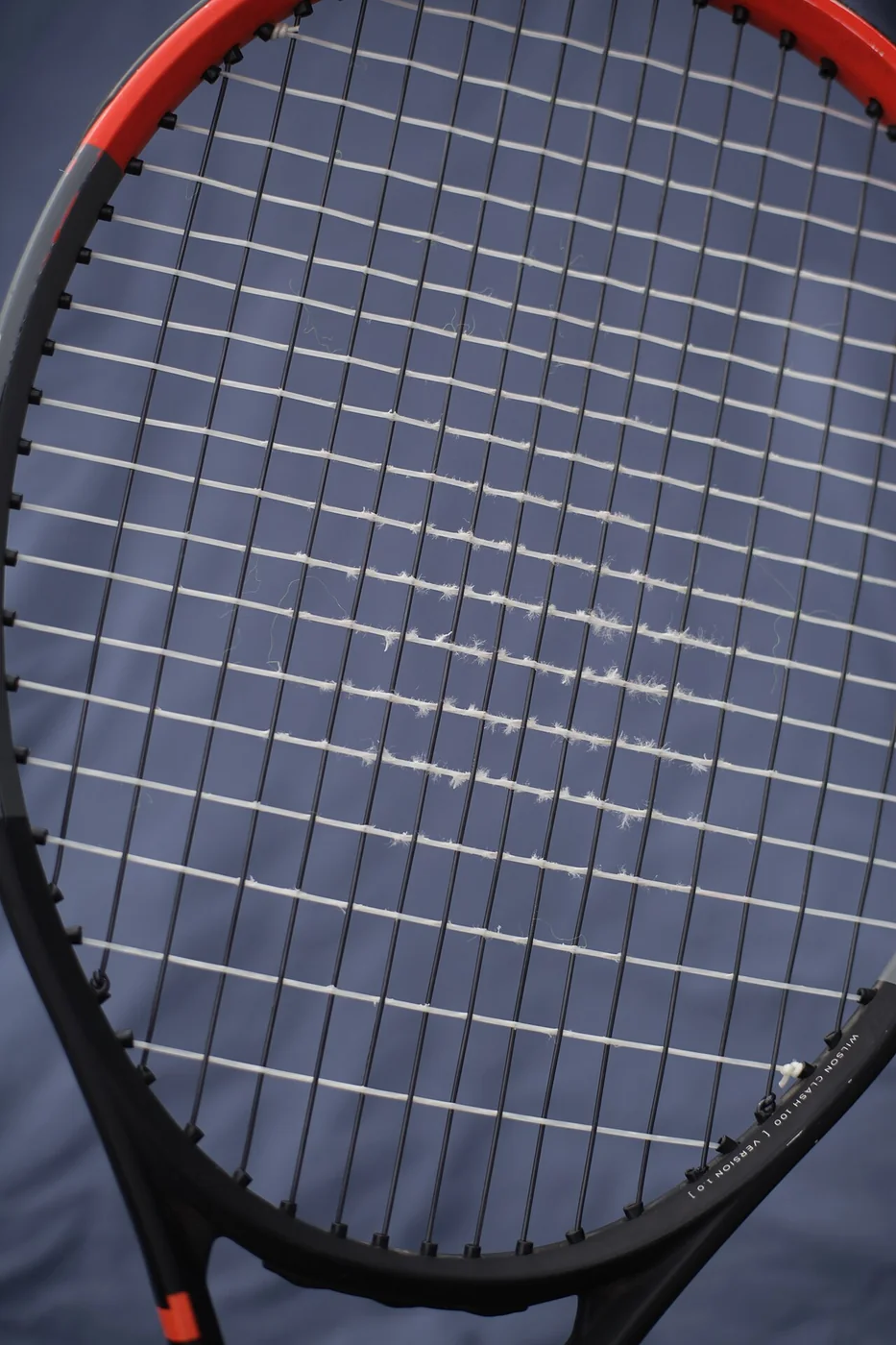
More grip can change the impact without delivering a fixed spin bonus
A later TWU experiment, published in 2016, used the same smooth round polyester in two surface conditions, before and after filing. That matters because comparing two unrelated strings also changes properties other than roughness. The measured static ball-to-string coefficient rose from 0.406 to 0.77 after roughening. The question was what that change did during impact, rather than whether the surface merely felt more abrasive.
The apparatus was deliberately unusual: a transparent support, four main strings under low tension, and tests both without crosses and with six crosses added. A spinning ball dropped onto the tilted stringbed at about 3.6 m/s. The arrangement made individual string deflection visible. It was not a full racquet struck at match speed, and its precise spin figures should not be pasted onto a player’s forehand.
Without crosses, the reported averages from four accepted impacts per surface condition were 396 rpm for the smooth string and 370 rpm for the filed string. That small experiment does not establish a general advantage for smooth strings. It shows why a much larger friction coefficient need not become a proportional increase in final spin. In this setup, some rotation produced earlier in contact was partly undone later as the relative motion and torque changed direction.
With crosses added, the filed surface produced more spin than the smooth surface under the tested conditions. The stringbed was stiffer, contact was shorter and the same reversal did not occur. The experiment’s own discussion says reversal is not expected in ordinary patterns at normal speeds in the way demonstrated by the unusual setup. The useful conclusion is conditional: what the surface does depends on the whole impact, not simply on whether it feels rough.
This also sharpens the familiar snapback explanation. It is tempting to picture a main sliding aside, waiting, then flicking up the back of the ball at the last instant. The 2016 analysis describes a continuous three-dimensional process. Lateral displacement changes the direction and leverage of the string force throughout contact, including while the string is stretching. Its contribution is not confined to a final visible return to the original position.
For an equipment decision, you do not need to reconstruct every force vector. You do need to avoid using ‘snapback’ as a magic word that connects any easy finger movement to a guaranteed extra number of revolutions. The string has to move in a useful way during the ball’s actual contact. A racquet photographed after a rally cannot reveal that timing.
Ask a better question before buying the next set
Start by locating the claim. If a manufacturer talks about texture or edges, is it describing ball contact, a measured spin test or simply the string’s shape? If a database lists friction, is it ball-to-string or string-to-string, static or sliding, a single material or an ordered main/cross combination? A value becomes useful when you know what was measured. Combining numbers from different interfaces does not produce a meaningful ranking.
Then locate the comparison. Switching from a round soft string to a stiff shaped polyester changes more than surface geometry. A higher launch angle, altered depth or a different willingness to swing can make the ball look heavier. Those may be useful differences in play, but they do not isolate the effect of roughness. If you lack a way to measure spin directly, describe what you observed—trajectory, depth, bounce and confidence—rather than inventing an rpm gain.
An experienced player can make the comparison more informative without turning practice into a laboratory. Keep the frame and balls comparable, record the main/cross orientation, gauge and requested tension, and use the same method and timing for any subsequent tension measurements. Include the shots that matter to you: a full rally swing, a hurried defensive contact and a compact return. Do not assume an advantage on one transfers unchanged to the others.
Return to the comparison after use. Record playing time and visible wear, and note whether the response that attracted you initially remains useful. Straight strings are not proof of high spin; displaced strings are not a precise diagnosis of how many revolutions have been lost. A consistent tension history and an honest playing log describe different parts of the setup. Neither replaces the other, and neither gives a complete friction history.
The practical choice may still be a shaped polyester, a smooth one or a hybrid. The research does not select a universal winner. It helps remove a false choice from the discussion: a string need not be either grippy or slippery in every sense. Ask what it grips, what it slides against and whether that behaviour remains useful in the strokes you actually play. That is a much more demanding standard than running a thumb across a fresh set.
Sources and further reading
TENNIS TENSION LAB
Check your racquet’s tension today.
Get a high-precision tension reading in under 10 seconds. Tension Lab tracks changes from your first reading and helps you see when to restring.
- High-precision tension measurement. Ready in under 10 seconds.
- Track every change in feel. See the full story over time.
- Time to restring? Never leave it to guesswork.
Keep reading
Why old poly can feel harsher even as its tension falls
Lower tension does not tell the whole story of worn polyester. Separate stringbed deflection, inter-string friction and changing launch behaviour before deciding when to restring.
7 min read
The first tension drop can mislead your next restring
A fair tension history separates the stringing-machine setting, the fresh stringbed reading and the first-session baseline. Here is how to compare strings without moving the starting line.
7 min read