A quieter racquet is not proof of a safer arm: what a dampener actually changes
The little rubber accessory can change the experience of a shot. The mistake is treating every quieter impact as evidence that less frame vibration reached your arm.
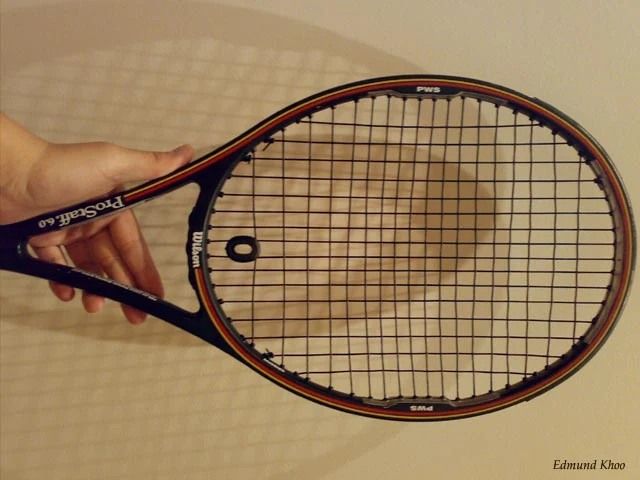
The most persuasive sales demonstration for a string dampener takes one shot. Hit a ball with the accessory fitted, remove it, and hit again. The ringing changes. For a player who dislikes that sound, the purchase can make sense immediately. But the demonstration has answered a question about the experience of impact, not established how much protection the elbow received.
That distinction keeps getting lost in equipment conversations. A Talk Tennis thread titled “Best dampeners,” started in September 2026, showed 24 replies and 619 views when consulted on 4 October. A separate Kimony discussion, begun in 2018 and active again in September 2026, showed 18 replies and 7K views. Those are cumulative forum counters, not search volumes. The interesting part is the recurring mixture of questions: sound, feel, whether the accessory falls out, and whether a more expensive design helps an uncomfortable arm.
The word vibration is doing too much work
Strings and the racquet frame do not have to vibrate in the same way for a player to experience one impact. An accessory attached to the strings may quiet their ringing without producing the same reduction in the lower-frequency vibration of the frame. If those two effects are bundled into the single word “shock,” a change that is easy to hear starts sounding like a medical benefit that has not been measured.
A 1999 Journal of Sports Sciences study is useful because its published abstract explicitly separates those effects. Twenty tennis players, ten men and ten women aged 18–29, took part. Researchers used two racquet models and stationary impacts at the geometric centre of the face and at a point 100 millimetres farther towards the tip, with and without string dampers. Participants could neither see nor hear the impacts and rated the discomfort immediately afterwards.
The abstract reports no significant difference in discomfort ratings between the damped and undamped conditions. Accelerometer traces at the handle showed that the dampers quickly absorbed high-frequency string vibration without attenuating lower-frequency frame vibration. Central impacts were more comfortable than the off-centre impacts in that experiment. A quieter stringbed and a less uncomfortable impact were therefore not interchangeable findings.
What a second experiment added—and what neither one proved
A 2005 study in the same journal investigated vibration reaching the forearm. Twenty participants held a racquet stationary in forehand and backhand positions while balls were fired at 20 metres per second towards two locations. The published abstract reports no significant difference between damped and undamped impacts in vibration amplitude at the resonant frequency at the wrist or elbow. It also reports no effect on grip force or the measured electrical activity of the forearm muscles after impact.
These are specific findings from stationary-impact experiments. They are not a season-long injury trial, a test of every accessory on sale today, or proof that every player will prefer the same sound. We read the published abstracts, rather than the subscription full papers. Their value here is narrower and important: ordinary string-damper claims should not jump from altered sound to demonstrated reduction of frame vibration or prevention of an elbow problem.
Nor does the research require dismissing a player who likes the damped sensation. A preferred sound can be part of a useful, familiar setup. Choosing it for that reason is perfectly coherent. The unsupported step is turning personal preference—or an anonymous report of less pain—into a clinical promise for the next buyer. A forum recommendation cannot establish what caused a person’s symptoms to change.
Buy for the problem the accessory can actually answer
If the ringing bothers you, sound is a legitimate selection criterion. If your current dampener repeatedly comes loose, secure fit in your actual string pattern matters more than a famous player’s logo. If it tears or deforms, longevity matters. The Kimony thread is useful as a record of those practical questions: participants discuss retention and wear as well as preferences. Their conflicting experiences are reasons to examine your own fit, not a controlled ranking of brands.
Check that the accessory is installed as its maker intends and remains seated during your normal hitting. A small round design, an extended design and a simple rubber band need not feel identical. Their attachment and added mass also need not be identical. We have not conducted a head-to-head playtest, so there is no invented winner here. Pay for a preference or a clearly described feature, rather than an unverified promise that a higher price means greater arm protection.
You can make the choice less impressionistic without pretending to own a laboratory. Keep the same racquet, string job and balls. Alternate short, ordinary hitting blocks with and without the accessory, and write down sound, feel and whether it stays put as separate observations. Do not deliberately create harsh off-centre hits to reproduce a paper. A pleasant first contact is worth noting; so is how the setup feels during routine rallying.
The accessory comes off before an acoustic tension measurement
There is a particularly practical reason for Tennis Tension Lab users to keep these effects separate. The app’s measurement preparation asks you to remove any vibration dampener. A device intended to change string vibration can interfere with the signal used for a sound-based reading. Follow the preparation instructions rather than assuming that a quieter tap simply indicates a different tension.
Use a consistent preparation routine for the baseline after a restring and for later readings: remove the dampener, use the same recorded racquet and string setup, and follow the app’s tapping guidance. Put the accessory back afterwards if you like playing with it. A reading taken with it attached should not be compared casually with one taken after removal and labelled tension loss. The preparation changed, so the comparison no longer isolates the string job’s evolution.
A tension estimate also does not measure arm protection. It cannot tell you whether a particular dampener prevents pain, and it cannot replace a complete assessment when discomfort persists. Continuing to play through pain because the sound is now softer would give the accessory a responsibility the evidence does not support. Stop aggravating the symptoms and seek appropriate assessment rather than treating the rubber piece as a repair for the arm.
The useful purchase question is refreshingly modest: does this accessory give me a sound and feel I prefer, and does it stay reliably in place? That can justify keeping it on the racquet. It does not require a claim that a quiet stringbed has solved every vibration problem. Listen to the difference, respect the limits of what it tells you, and remove the dampener when it is time to measure.
Sources and further reading
- Talk Tennis community — Best dampeners
- Talk Tennis community — Kimony Quake Buster Shock Absorber
- Journal of Sports Sciences / Europe PMC — The effect of tennis racket string vibration dampers on racket handle vibrations and discomfort following impacts — published abstract
- Journal of Sports Sciences / Europe PMC — String vibration dampers do not reduce racket frame vibration transfer to the forearm — published abstract
- Tennis Tension Lab — Tennis Tension Lab support: measurement preparation
TENNIS TENSION LAB
Check your racquet’s tension today.
Get a high-precision tension reading in under 10 seconds. Tension Lab tracks changes from your first reading and helps you see when to restring.
- High-precision tension measurement. Ready in under 10 seconds.
- Track every change in feel. See the full story over time.
- Time to restring? Never leave it to guesswork.
Keep reading

Why old poly can feel harsher even as its tension falls
Lower tension does not tell the whole story of worn polyester. Separate stringbed deflection, inter-string friction and changing launch behaviour before deciding when to restring.
7 min readThe first tension drop can mislead your next restring
A fair tension history separates the stringing-machine setting, the fresh stringbed reading and the first-session baseline. Here is how to compare strings without moving the starting line.
7 min read12 o’clock or 3 and 9? The same four grams can change a racquet in different ways
Racquet weight at 12 o’clock and at 3 and 9 changes different rotational demands. A worked example separates swingweight, twist resistance and the limits of laboratory evidence.
8 min read