EZONE 98 vs 100: you are changing more than two square inches
A two-square-inch change is an easy story. The specification sheet is less simple—and more useful when your return, forehand and tired second set disagree about which racquet to buy.
The shopping question sounds tidy: do I want the precision of an EZONE 98 or the forgiveness of an EZONE 100? The first mistake is hidden in the question. Moving between these two frames is not an experiment in which only head area changes. Yonex’s official US listings give different balance points and different frame-width profiles too. Whatever you feel in a demo belongs to the complete racquet and its setup, not automatically to the number printed after EZONE.
This comparison concerns the models identified by parent SKUs EZ0898 and EZ08100 in the official listings reviewed for this article. The EZONE 100 page explicitly calls the model eighth generation. Keep those identifiers with any comparison: a used frame from another generation, a 98 Tour, a light version or an extended-length version is a different proposition, even when the paint and family name look familiar.
The published differences are visible before either racquet hits a ball
| Published item | EZONE 98 · EZ0898 | EZONE 100 · EZ08100 |
|---|---|---|
| Head area | 98 sq in | 100 sq in |
| Length | 27 in | 27 in |
| Balance point | 315 mm | 320 mm |
| Frame width, listed sequence | 23.8 / 24.5 / 19.5 mm | 24.5 / 26.5 / 23.0 mm |
| String pattern | 16 × 19 | 16 × 19 |
| Stringing advice | 45–60 lb | 45–60 lb |
| Listed materials | HM Graphite / MINOLON / 2G Namd SPEED / VDM | HM Graphite / MINOLON / 2G Namd SPEED / VDM |
The head-area increase from 98 to 100 square inches is about 2.04%, calculated as 2 ÷ 98. That is an area ratio, not a forecast of 2.04% more ball speed, a 2.04% larger useful sweet spot or 2.04% fewer mishits. The specifications also change elsewhere. Reducing a comparison to the area ratio would give the smaller number more explanatory power than it deserves.
The listed balance point moves by 5 mm. That tells us there is a static-balance difference; it does not supply the swingweight of the demo in your hand. Nor do the three published width values function as a flex rating. A thicker listed section is a geometrical fact, not a measured percentage improvement in power or comfort. Without measurements of the actual samples, those consequences should remain questions to explore.
Both lists say 16 × 19, but equal string counts do not establish identical spacing throughout the hitting area. Likewise, the same material names do not reveal the amount, placement or full construction of each material. A catalogue is useful for identifying what is being compared. It cannot turn two complete designs into the same frame with only a different hoop size.
Choose a problem before choosing a winner
A good demo begins with the part of your current game you want to change. Perhaps the middle-of-the-racquet forehand is already fine, but stretched returns die short. Perhaps your compact backhand is reliable until the second set, when preparation gets late. Or perhaps depth is easy and the unwanted variation appears when you accelerate. These are different buying questions. “Which one is better?” hides the distinction.
Tennis Warehouse University’s explanation of power potential is useful here. It describes measuring how much of the combined impact speed is returned to the ball at different stringbed locations. Its maps distinguish the centre, periphery, tip and throat. The relevant lesson is that rebound behaviour has a location: two racquets can differ more at one contact point than another. The article is a general measurement explanation, not an eighth-generation EZONE test.
TWU also separates maximum power potential from the location that produces the fastest actual shot. Swinging motion matters, and the racquet still has to be brought to the ball. Consequently, a favourable rebound property cannot by itself decide which frame makes you hit better over a match. This is why “more powerful” can be a useful description of one controlled comparison and an incomplete answer to a purchasing question.
For your own demo, let ordinary centre contacts, less comfortable contacts and compact defensive replies remain separate observations. Do not deliberately hit the frame to create a torture test. Watch the contacts that already occur in realistic points: which ones cost depth, which ones change direction unexpectedly, and which ones still leave a playable next ball? A frame that improves a recurring problem deserves more attention than one spectacular forehand in cooperative hitting.
The strings can quietly become the third racquet in the comparison
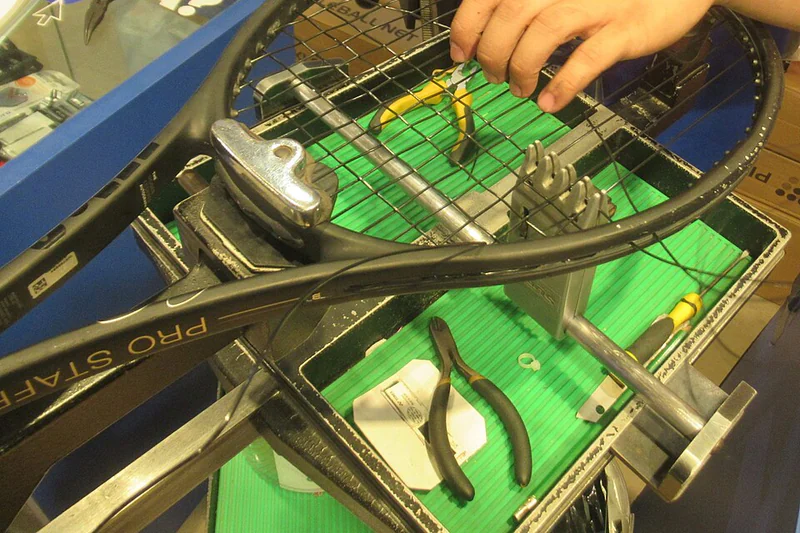
A shop demo with tired polyester and another with fresh multifilament do not isolate the frames. Even the same string model at the same originally requested tension may have different playing histories. Before attributing a higher launch, a duller response or an easier depth to the 98 or 100, record the string, gauge, installation information available and signs of wear. If those details are unknown, keep the uncertainty in the verdict rather than replacing it with confidence.
The shared 45–60 lb range is manufacturer stringing advice, not a declaration that every setting within it is equally suitable for you, and not proof that one nominal setting makes the two beds respond identically. For a closer comparison, use the same string model and gauge, the same nominal installation target and reasonably similar time since stringing and hitting exposure. The purpose is to reduce uncontrolled differences, not to pretend that two finished racquets have become mechanically identical.
Keep grip size and the accessories you actually play with in the comparison as well. An overgrip, a dampener or added mass can change the finished object you are judging. If a shop can measure the ready-to-play mass, balance and swingweight, retain those values with the notes. Do not substitute an unstrung catalogue figure for a measurement of a customised demo, and do not mistake a pair of unmatched samples for the full range of production.
What would make you choose the 98—and what would make you change your mind?
The useful case for the 98 is a result you can describe: for example, a more repeatable trajectory when accelerating your usual rally ball, without a cost on the return that matters more to you. The useful case for the 100 could be less loss of depth on your recurring imperfect contacts, without making your ordinary attacking ball harder to place. These are examples of what a player might observe, not results measured for this article or promises about either model.
Give both frames the same chance to answer the hard question. If one is used only during relaxed warm-up and the other only against a strong returner, the impressions may be sincere but the comparison is unfair. Alternate under similar conditions, include points as well as cooperative rallying and revisit the choice when you have played long enough for your normal preparation habits to appear. There is no universal number of minutes that turns this into a controlled trial.
The 100 should not have to apologise for its head size, and the 98 should not have to prove the buyer is advanced. Yonex positions both for intermediate-to-advanced players in these listings. That is the manufacturer’s positioning, not a qualification exam. The experienced player’s job is to find which combination of responses supports their actual tennis, including the less photogenic balls they must play under pressure.
After the demo, write the choice as a tradeoff rather than a slogan. “I preferred this frame on short-preparation returns and accepted this difference on full swings” is more useful than “100 has power, 98 has control”. It names the reason for the purchase and the condition under which you might reconsider. If the decision remains unclear, more tightly matched strings and another relevant session are more informative than inventing certainty from the size label.
The two square inches are real. So are the differences in the published balance and width profiles, and so is the influence of the completed setup. Start with the official model identifiers, then ask each demo to solve a specific problem in your game. The best choice between these EZONEs is the one you can explain through repeatable situations on court, not the one that wins a contest between two numbers.
Sources and further reading
TENNIS TENSION LAB
Check your racquet’s tension today.
Get a high-precision tension reading in under 10 seconds. Tension Lab tracks changes from your first reading and helps you see when to restring.
- High-precision tension measurement. Ready in under 10 seconds.
- Track every change in feel. See the full story over time.
- Time to restring? Never leave it to guesswork.
Keep reading
The first tension drop can mislead your next restring
A fair tension history separates the stringing-machine setting, the fresh stringbed reading and the first-session baseline. Here is how to compare strings without moving the starting line.
7 min read
Both racquets say 305 g. Why does one keep arriving late?
Identical listed weight does not mean identical swingweight. Read mass, balance and rotational resistance together before choosing a new frame or matching a second racquet.
8 min read
12 o’clock or 3 and 9? The same four grams can change a racquet in different ways
Racquet weight at 12 o’clock and at 3 and 9 changes different rotational demands. A worked example separates swingweight, twist resistance and the limits of laboratory evidence.
8 min read