No major title. A 72.5% deciding-set record. How should we remember Nishikori?
The final match ended in straight sets. One of the most revealing numbers in his career belongs to the matches that did not.
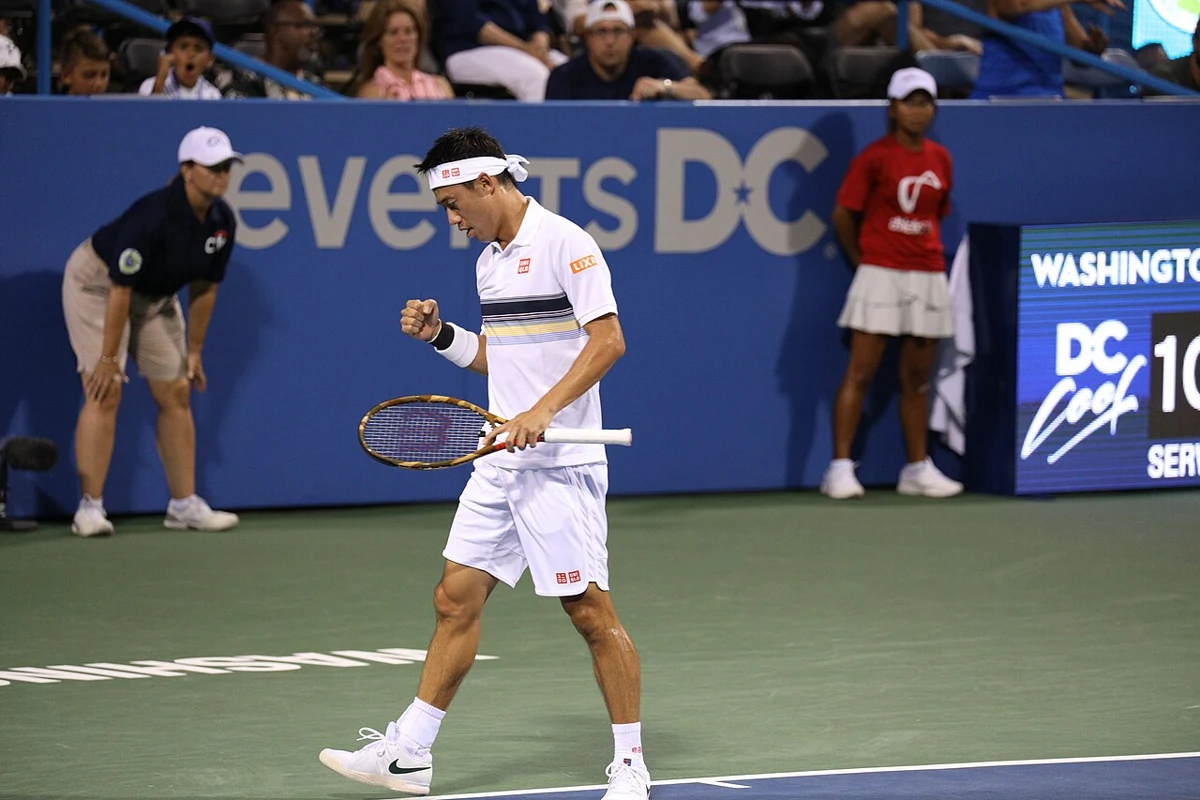
Kei Nishikori’s final professional match did not reach a deciding set. According to BBC Sport’s 1 October 2026 report, Frances Tiafoe beat him 6–4, 6–4 in Tokyo. The farewell included a lap of the main court, messages from former opponents and an emotional Nishikori telling the crowd he was proud to have kept fighting to the finish.
Near the end of the report sat a number that tells a different part of his story: a 72.5% win rate in deciding sets. The BBC placed it third in ATP Tour history, behind Bjorn Borg’s 73.4% and John McEnroe’s 72.8%. For a player whose career is so often introduced with the Grand Slam title he never won, that is a striking way to turn the conversation.
It deserves more than a social-media graphic calling him the ultimate fighter. A deciding-set record measures something specific and valuable. It does not measure every form of competitive courage, and it cannot tell us exactly what Nishikori thought before a crucial return. The number becomes more interesting when we keep its meaning intact.
First, count the right matches
In the familiar best-of-three format, the deciding set is the third; in best-of-five, it is the fifth. The defining feature is that the players have reached the last set needed to separate them. A straight-sets win contributes to a player’s overall record but not to that ordinary deciding-set comparison. Neither does a straight-sets defeat, including the Tokyo farewell.
So 72.5% is not Nishikori’s overall career match-winning percentage. It is not his conversion rate on break points, his winning percentage in tie-breaks or a statement that 72.5% of his matches became long battles. Those are different questions with different denominators. Even a reader who never calculates a statistic can avoid the biggest error by asking one thing: which matches were allowed into this count?
The BBC report gives the percentages and the historical order, but not the underlying win-loss totals, minimum-match eligibility or detailed treatment of every match format and retirement. This article therefore retains the ranking as reported rather than presenting an independently rebuilt leaderboard. It would be false precision to turn the rounded percentage into an invented number of wins.
That limitation does not make the achievement trivial. Repeatedly winning more than seven of every ten matches in a defined deciding-set record is exceptional. It does mean the figure should describe the record it came from, instead of quietly expanding into a claim about all tennis pressure.
A deciding set is not always a comeback
There are two common paths to one set all. You can lose the first set and win the second, or win the first and lose the second. Both arrive at the same score; they may feel entirely different to the players. A single deciding-set percentage merges those paths. It cannot show how often Nishikori reversed a bad start, how often he recovered from losing momentum or which sort of opponent made either situation difficult.
It also merges matches played under different circumstances. Surface, opponent, career stage and the work already done can all change what the last set asks of a player. A strong aggregated record does not prove that one breathing routine, one return position or one mental phrase caused it. To explain those mechanisms would require evidence that the farewell report does not provide.

Nor should the record become a demand that he ought to have won any particular future match. A historical percentage is not a personalised forecast that ignores the opponent and conditions. Sport is not obliged to deliver the long-run average on the next occasion. The same reason makes it unfair to use one lost decider as proof that a player has suddenly lost his competitive character.
The missing trophy can swallow the rest of the career
Nishikori reached the 2014 US Open final after beating the then world No. 1, Novak Djokovic, in the semi-final. He became the first Japanese man to reach a major singles final, where he faced Marin Cilic. In Rio two years later, he beat Rafael Nadal to win Olympic bronze. The BBC farewell report counted 12 ATP Tour singles titles and 40 victories over top-10 opponents across his career.
Those results do not need to be inflated into something they were not. A final is not a major title, and bronze is not gold. But nor do those distinctions justify treating the actual achievements as footnotes to an absence. If the only meaningful category is Grand Slam champion, much of what makes the tour compelling disappears: beating a great opponent, opening a path for a country and sustaining a difficult career.
The report also noted that injuries interrupted Nishikori’s 19-year career and that his example inspired players including Naomi Osaka. It does not tell us what he would have won in an injury-free alternative history. Imagining that career can be a tempting fan conversation, but it should not replace the one that happened. His deciding-set record is one unusually clear part of the career we can discuss without inventing an extra trophy.
What a club player can take from the number
The useful response is not to copy a gesture from an archive photograph or resolve never to feel nervous. It is to look more accurately at your own close matches. Start by separating genuine final sets from the other formats you play. A third set and a match tie-break may both decide a match, but combining them without a label makes later comparisons hard to interpret.
Then add the route to the score: did you level after losing the opening set, or did the opponent catch you? Alongside the result, note one concrete thing that changed. Perhaps you started more return points, stopped giving away the first ball after a serve, or found a usable rally height. These are hypothetical examples for your record, not an account of Nishikori’s methods.
This need not become another spreadsheet competition. Four wins from six deciders is 66.7%; losing the seventh drops that small sample to 57.1%. The arithmetic changes sharply without proving that your personality has changed. Keep the match notes and the sample size together. A short run can suggest a useful question for a coach, but it cannot support a grand theory of your nerve.
A practical review might begin with two matches that reached the final set in opposite ways. What was working before the change of set? Which choice could you still repeat afterward? Did you preserve a productive pattern or abandon it merely because the scoreboard became more dramatic? That review can lead to a specific practice task. “Be as tough as Nishikori” cannot.
At his farewell, Nishikori spoke about having fought to the end. The 72.5% figure gives that familiar phrase unusual statistical weight, while still leaving the human experience of each match untold. His career does not become a failure because the major trophy is missing, and the number does not make him immune to defeat. Together, the record and the farewell describe something more convincing: a player who made reaching the last set an uncomfortable prospect for a remarkable number of opponents.
Sources and further reading
TENNIS TENSION LAB
Check your racquet’s tension today.
Get a high-precision tension reading in under 10 seconds. Tension Lab tracks changes from your first reading and helps you see when to restring.
- High-precision tension measurement. Ready in under 10 seconds.
- Track every change in feel. See the full story over time.
- Time to restring? Never leave it to guesswork.
Keep reading
Djokovic plays less. Why is the last part of a tournament still so hard?
A lighter calendar and a deep Grand Slam run answer different questions. Djokovic’s comments on an emptying tank offer a better way to think about tournament readiness than counting entries.
8 min read
Zverev won 39 of 42 first-serve points. That is not an ace statistic
Alexander Zverev’s early service dominance against Ben Shelton in the 2026 US Open final shows why first-serve percentage, aces and points won tell different stories.
8 min read