Wilson Defyer 98 or 100? The argument is about more than head size
One player retires a favourite frame; another gives up after weeks of adjustments. Both can be describing the same new racquet honestly.

A new racquet rarely divides opinion as neatly as its launch promises suggest. In the Defyer discussion, one player says the 98 finally replaced a trusted H22, while another describes a long experiment with strings and added weight that never clicked. The disagreement is useful. It tells a prospective buyer to ask what each player needed from the racquet, rather than treating the loudest verdict as a verdict for everyone.
There is visible demand for that answer. On 4 October 2026, the Talk Tennis section displayed 108K cumulative views for its Defyer 98 Pro thread and 36K for the separate 100 thread. A broader Python/Defyer discussion showed 357K. Those are abbreviated forum counters, not Google search volumes, unique buyers or approval ratings. A long argument generates traffic too; popularity establishes a question worth examining, not a winning racquet.
First identify the frame behind the name
Wilson’s official Japanese Defyer page identifies the 98 Pro V1 as 98 square inches, average listed weight 305 g, a 16 × 20 pattern and 27-inch length. Its 100 V1 is 100 square inches, average listed weight 300 g, 16 × 19 and the same length. The additional cross string is easy to miss when someone describes the range simply as two sizes of a spin racquet.
The same official page explains another source of confusion: the initial Concept Editions carry REDLINE lettering, with regular DEFYER-branded models following as those sell out. That explanation establishes the naming and cosmetic relationship Wilson describes. It does not establish that an unidentified prototype, a professional’s customised frame and a retail sample have identical construction or measurements. Ask which version a review actually concerns before borrowing its conclusion.
Tennis Warehouse’s retail listings add a revealing contrast. The 98 Pro is listed at 323 g strung and swingweight 319; the 100 at 318 g strung and swingweight 326. These are retailer specifications, not measurements made by this publication or guaranteed values for every sample. Nevertheless, they show why assuming that the lighter listed racquet must always be easier to swing is a poor starting point.
Do not combine Wilson’s nominal weights with the retailer’s strung weights as though they came from the same pair of racquets on one scale. Strings and finished configurations differ. If a shop measures your actual demos, keep those numbers separately. Their mass, balance, swingweight and installed accessories describe the objects you are about to hit with more closely than a blended spreadsheet assembled from several websites.
The same family can produce opposite preferences
Current community posts do not tell one consistent story. Some players find the 98 and 100 recognisably related; others prefer the 100 after disliking the 98. There are also reports of liking the 98’s attacking response but struggling to keep the 100’s depth under control. These are personal experiences, with different skills, strings and modifications. The contradiction is the point: a shared family name does not erase the player’s interaction with the finished frame.
The retailer positions the 98 Pro as the more control-oriented model, describing a lower launch than its siblings, while presenting the 100 as an aggressive power-and-spin option. Those are the retailer’s descriptions. Treat them as questions for a demo: can you accelerate your usual forehand without an unwanted trajectory change, and can you still produce useful depth when preparation is rushed? Neither answer follows automatically from the catalogue wording.
Wilson markets TORQ SHAFT, AIRFOIL BUMPER and SI3D as parts of the design, with claims about stability, movement through the air and flex behaviour. Knowing the intended design is helpful, but these names are not independent measurements of your spin rate or accuracy. This article has not conducted a Defyer playtest. No percentage gain, injury advantage or guaranteed improvement is being inferred from the technology names.
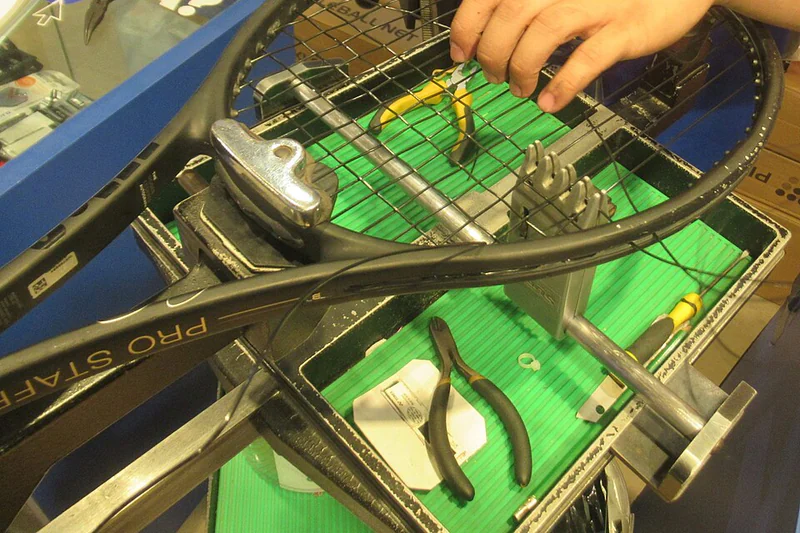
A demo can accidentally become a string comparison
One useful detail in the 100 discussion is a player who initially compared it with the 98 from memory because the other racquet was away being strung. Later posts describe different strings, added hoop weight and different playing time. That is ordinary club tennis, not laboratory misconduct. But it should temper a sweeping statement about the frame: the experience is real, while the explanation may still be uncertain.
For a meaningful comparison, record the string model and gauge, the requested tension, how recently each racquet was strung and the approximate hitting time. Fresh multifilament against older polyester is not a clean comparison of the two Defyers. Nor does matching the number on the stringing ticket make two different stringbeds identical. If the shop cannot supply their history, write “unknown” instead of quietly assuming equality.
The retailer lists 47–57 lb for both models. That shared range is not a recommendation to choose its top or bottom automatically, and it does not predict your preferred setting. Begin from a sensible setup you know, with the shop’s help when necessary. Changing frame, string family, gauge and tension together may create a setup you enjoy, but it leaves you little understanding of what produced the change.
Accessories deserve the same honesty. Several owners discuss leather grips, handle weight or a few grams around the hoop. Those reports concern modified racquets. Before copying a recipe, find out the starting measurements and the problem it was intended to solve. Adding exactly the same mass to a different sample need not produce the same finished balance or swingweight, much less the same confidence on a pressured return.
Ask the shot that costs you points
A player moving from a demanding control frame may be shopping for easier depth late in a match. Someone leaving a lively power frame may want a more predictable attacking ball. Put those two players on the same demo court and an opposite preference would be unsurprising. The first question is therefore practical: which recurring ball do you want the Defyer to improve without sacrificing something more valuable?
Use situations that already appear in your matches: the blocked first-serve return, the high backhand under pressure, the forehand you normally attack and the volley reached a little late. Separate a satisfying sound from a useful result. Observe whether the ball lands where you intended, whether your next recovery is comfortable and whether you can repeat the action. A single spectacular winner tells less than a familiar difficult exchange.
Alternate the racquets under comparable conditions and include points, not only cooperative hitting. A frame that feels wonderful when every ball arrives at waist height may ask more of your timing during a live rally. Conversely, an initially unfamiliar response may become understandable after a fair session. There is no obligation to rescue a purchase by modifying it indefinitely, and no prestige attached to choosing the smaller head.
The defensible conclusion may be specific rather than dramatic: “I preferred the 98 on my attacking forehand, but the 100 helped my short preparation.” Decide which tradeoff matters more in your own scoreline. The Defyer discussion is valuable because it exposes that tradeoff; it becomes misleading only when someone else’s success or frustration is presented as a universal property. Buy the response you can repeat, not the argument you enjoyed reading.
Sources and further reading
- Wilson Japan — DEFYER: official model range and Concept Edition information
- Tennis Warehouse — Wilson Defyer 98 Pro Racquet: overview and specifications
- Tennis Warehouse — Wilson Defyer 100 Racquet: overview and specifications
- Talk Tennis community — Wilson Defyer 98 Pro V1, discussion page 42
- Talk Tennis community — Wilson Defyer 100 V1, discussion page 8
- Talk Tennis community — Wilson Python/ Defyer - Released July 2026: community cumulative counter
TENNIS TENSION LAB
Check your racquet’s tension today.
Get a high-precision tension reading in under 10 seconds. Tension Lab tracks changes from your first reading and helps you see when to restring.
- High-precision tension measurement. Ready in under 10 seconds.
- Track every change in feel. See the full story over time.
- Time to restring? Never leave it to guesswork.
Keep reading

EZONE 98 vs 100: you are changing more than two square inches
The eighth-generation Yonex EZONE 98 and 100 differ in listed balance and frame width as well as head size. Read the official dimensions before blaming every demo difference on 98 versus 100.
8 min readThe first tension drop can mislead your next restring
A fair tension history separates the stringing-machine setting, the fresh stringbed reading and the first-session baseline. Here is how to compare strings without moving the starting line.
7 min readBoth racquets say 305 g. Why does one keep arriving late?
Identical listed weight does not mean identical swingweight. Read mass, balance and rotational resistance together before choosing a new frame or matching a second racquet.
8 min read