Same gut, same poly—why reversing mains and crosses makes a different hybrid
A slash between two string names hides half the specification. Main-and-cross order changes the contact, the movement and the question your next string job is testing.
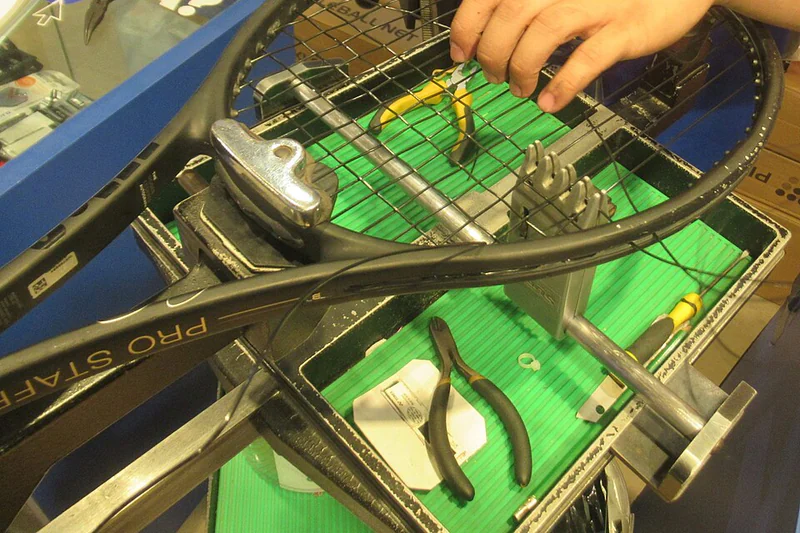
“Gut and poly at 50 pounds” is not a complete stringing order. It leaves out a decision capable of changing the way the two strings work together: which one runs through the mains and which one through the crosses. Reversing them does not preserve the same setup merely because the packets on the counter are unchanged.
The mains are the strings running from the top of the head towards the throat; the crosses run across them. In the oblique impact used to explain topspin, the mains can move sideways over the crosses and then return. Put the other material in each position and you have changed the moving string, the surface it travels across and part of the interaction with the ball. “Same ingredients” is an incomplete description of a structure with direction.
The historical measurement that makes the point
Tennis Warehouse University’s static-friction article, published in 2010 and revised in February 2011, includes ordered hybrid combinations. Its table is unusually useful here because it lists both orientations of the same named pairs. The measured property is the coefficient of static friction between strings: part of the resistance that must be overcome to start them moving relative to each other.
| Main string | Cross string | Static friction coefficient |
|---|---|---|
| Babolat Tonic + 1.35 natural gut | Babolat Pro Hurricane Tour 17 polyester | 0.066 |
| Babolat Pro Hurricane Tour 17 polyester | Babolat Tonic + 1.35 natural gut | 0.201 |
| Natural gut from Volkl V-Fuse 16 hybrid | Polyester from Volkl V-Fuse 16 hybrid | 0.063 |
| Polyester from Volkl V-Fuse 16 hybrid | Natural gut from Volkl V-Fuse 16 hybrid | 0.236 |
The direction is clear in these tested combinations: gut mains with polyester crosses had a lower static coefficient than the reverse arrangement. The result is not a small bookkeeping difference. But the table is also easy to misuse. Dividing one coefficient by another does not tell you how many times more topspin a player will hit, nor does it rank every natural-gut and polyester combination sold today.
The normal load is important too. The paper shows that friction behaviour can change as the force pressing strings together changes. A value measured at one contact load is not a universal label attached to a string for every impact. And the 13 lb in this table does not mean the racquets were strung at 13 lb. Confusing those quantities turns a useful measurement into a very odd stringing recommendation.
Why swapping the positions can change the resistance
TWU proposed explanations involving deformation and wear. A relatively hard main pressing into a softer cross may have to climb out of a local indentation and push through material as it travels. A softer main over a harder cross deforms differently. The article also suggests that broken or frayed fibres in a cross can form obstacles to movement. These are proposed mechanisms in that analysis, not a diagnosis of every hybrid on a club court.
The broader lesson is that friction belongs to the contact between two strings under particular conditions. It is not fully described by calling one packet “slippery” and the other “soft.” Which string is moving across which surface matters. The same two materials do not necessarily meet the ball and each other in mechanically equivalent ways after reversal.
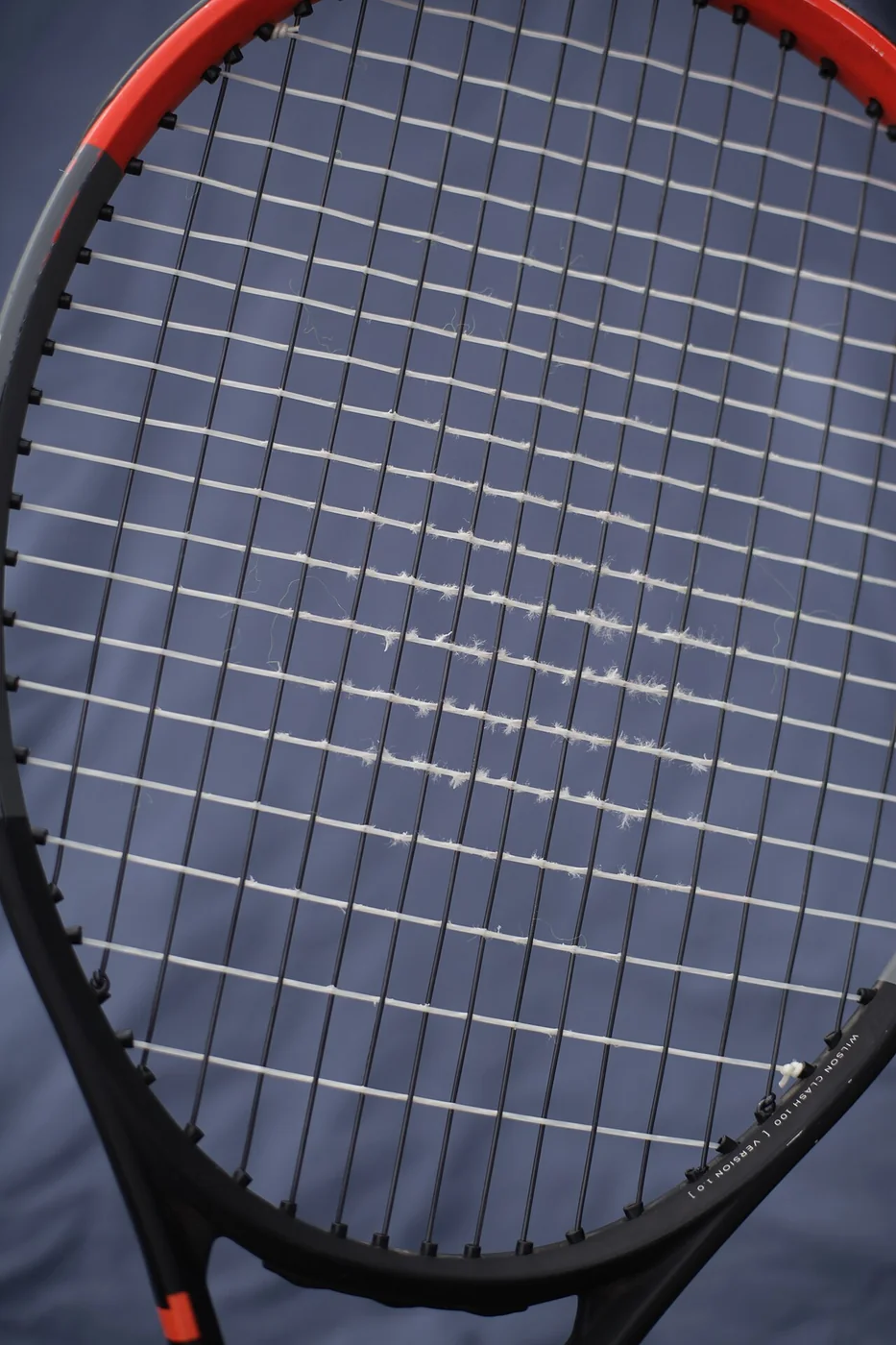
Ball-to-string friction is another part of the picture. In a separate February 2012 study, TWU examined motion parallel and perpendicular to the length of a string. The measured interaction differed by direction, with the perpendicular direction producing greater friction for strings measured both ways. The apparatus and demonstrations help explain why a main and a cross are not simply interchangeable contact surfaces.
Those demonstrations included stripped-down rigs intended to reveal mechanisms. They were not normal match stringbeds or a modern head-to-head playtest of two retail hybrids. They support the need to name the arrangement precisely. They do not supply a universal percentage saying how much of every shot belongs to the mains, nor a promise that one orientation is always the best choice.
Which orientation should you actually try?
Begin with the problem, not with a professional’s abbreviated equipment list. Are you trying to change the feel of a full-polyester bed, improve a particular trajectory, preserve a response you like or manage the cost of restringing? A useful recommendation has to connect the proposed main and cross to that objective. “This player uses gut and poly” still leaves you short of the information needed to copy even the arrangement.
For a player specifically interested in the low-friction behaviour shown in the historical table, gut mains and polyester crosses are the orientation that produced it in those pairs. That is a reason to investigate the configuration, with an appropriate product choice and stringer’s advice. It is not evidence that reversing any hybrid must ruin control or that every player will prefer the lower coefficient.
Equally, a familiar polyester-main setup should not be dismissed solely because a different historical pairing had a higher friction figure. The player has to manage the complete response: trajectory, depth, comfort, durability and the swing that feels usable. The published numbers answer a narrower mechanical question than “which setup will help me win?”
Write the experiment down before the racquet reaches the machine
Record a full line for each direction: main model, material, gauge and requested tension; cross model, material, gauge and requested tension. Add the racquet, pattern, stringer, date and any pre-stretch or other relevant process. It should be possible to reproduce the job from the record without guessing what a slash between two brand names means.
| Item | Arrangement A | Arrangement B |
|---|---|---|
| Mains | Product A; gauge; reference tension | Product B; gauge; reference tension |
| Crosses | Product B; gauge; reference tension | Product A; gauge; reference tension |
| Process | Machine, stringer, pre-stretch and date | Record the same fields; note any change |
| Court observations | Launch, depth spread, comfort, usable response | The same observations under comparable conditions |
Decide what to hold constant. You might retain the requested tension for each position, or follow a material-specific recommendation when swapping the strings. Those are different comparisons. Either can be useful, but a record that says only “reversed hybrid” conceals the second change if the tensions also moved. There is no universal tension split prescribed by the friction table.
Use comparable fresh jobs where practical, rather than placing a new reversed hybrid against one that has already played for weeks. Keep balls and court conditions reasonably consistent, and include your ordinary rally and pressure shots, not only the swing that makes the new setup look impressive. This is a proposed comparison method, not a playtest we have conducted.
The best hybrid description survives the first few sessions
The initial response is only part of the decision. Note how many playing hours have passed, visible wear at intersections and any change in the trajectory you can repeat. A photo can document fraying or a notch. It cannot turn that mark into a measured friction coefficient or an exact remaining lifespan. Let the observation inform the comparison without pretending it measures everything.
A tension measurement adds useful context when taken under comparable conditions, but a single overall estimate does not separately report the force in every main and cross. Nor does it measure the speed of snapback. Preserve the original main-and-cross specification beside later readings so that a changed response is not reduced to one number with the arrangement forgotten.
The durable takeaway is simple enough to put on the stringing ticket: two string names are not a setup until their positions are specified. The TWU measurements show why reversing a familiar pair can produce a different contact problem. The court comparison determines whether that different response serves your tennis. Keep both pieces of information, and “gut/poly” becomes a repeatable choice rather than a guess.
Sources and further reading
TENNIS TENSION LAB
Check your racquet’s tension today.
Get a high-precision tension reading in under 10 seconds. Tension Lab tracks changes from your first reading and helps you see when to restring.
- High-precision tension measurement. Ready in under 10 seconds.
- Track every change in feel. See the full story over time.
- Time to restring? Never leave it to guesswork.
Keep reading

Jack Draper’s natural-gut experiment challenges the “serious players use poly” rule
What Jack Draper’s reported move from polyester toward natural gut tells experienced players about string stiffness, useful life and choosing a setup without copying a pro’s prescription.
8 min readLower tension, higher launch—but where did the topspin go?
Lower string tension can raise the launch angle without delivering more topspin. What TWU’s string-movement experiments reveal, and how to judge a useful low-tension setup.
9 min read
Should a spin string be rough or slippery? You are asking about two different surfaces
Ball-to-string grip and friction between mains and crosses do different jobs. How to read spin claims, hybrid tests and visible string movement without confusing them.
8 min read