Lower tension, higher launch—but where did the topspin go?
A ball that clears the net higher is not automatically spinning faster. Before lowering tension again, separate launch, depth and the swing you have to make.
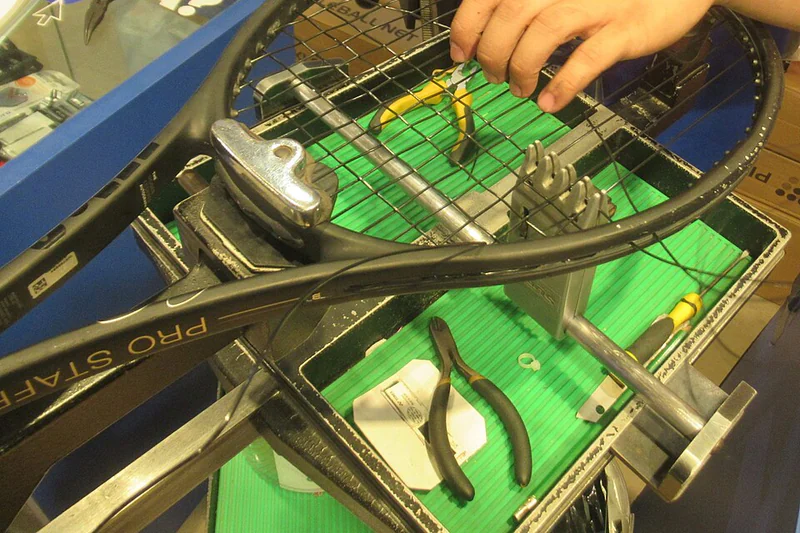
The new string job clears the net more easily. At first, that feels like free topspin. Then the same confident swing sends another ball beyond the baseline, and the obvious adjustment—swinging more cautiously—takes away the reason you lowered the tension in the first place. The ball is leaving higher. That does not establish that it is rotating faster.
This is the uncomfortable part of the low-tension discussion: string movement can help spin, but more movement is not an unlimited upgrade. A string has to return useful energy while the ball is still there. The direction of the force and the timing of that return matter as much as the distance a main string travels. Lower tension may suit your game beautifully; it is not a guarantee that every additional reduction will add more topspin.
A high ball is a trajectory, not a spin measurement
Launch angle describes the direction in which the ball leaves the racquet. Spin describes its rotation. They interact during flight, but they are not interchangeable observations. A shot can leave higher and still carry insufficient topspin to land where you intended. Calling every higher arc “more spin” hides the distinction you need when deciding whether a new tension is working.
For the player, the useful question is therefore more specific than “does it spin?” Can you keep your intended swing, clear the net with the margin you want, and repeatedly land in your chosen depth window? A setup that gives you extra clearance but forces you to slow down or close the face more than intended has changed the shot. Whether that change is helpful depends on the shot you were trying to build.
The experiment that breaks the simple rule
In a March 2011 Tennis Warehouse University study, Crawford Lindsey compared five strings in Prince EXO3 Hybrid Red 102 racquets across four deliberately contrasting setups: 16×19 and 16×10 patterns, each at 30 and 60 lb. The unusually open 16×10 arrangement was made for the experiment to expose string behaviour. It should not be read as an instruction to omit crosses from your racquet.
Balls were fired at a stationary but free-swinging racquet, and impacts were filmed at 420 frames per second. The researcher analysed selected impacts and normalized results for small differences in incoming conditions. This was a controlled mechanism study, not a player trial establishing the best match tension. Even the paper’s stiffness values used nearby laboratory test conditions rather than measurements exactly matching every installed setup.
The 16×10 setup at 60 lb produced the most spin for every tested string. Its 30 lb counterpart was generally the poorest. That alone challenges the idea that the loosest, most open stringbed must be the spin winner. Yet the more familiar 16×19 results did not give a universal instruction to increase tension either: some strings produced more spin at 60 lb, while others produced more at 30 lb.
| Tested string | 30 lb | 60 lb | Direction in this comparison |
|---|---|---|---|
| Babolat RPM Blast 16 | 723 rpm | 870 rpm | Higher at 60 lb |
| Polyfibre TCS 16 | 829 rpm | 775 rpm | Higher at 30 lb |
| Prince Synthetic Gut with Duraflex 16 | 814 rpm | 665 rpm | Higher at 30 lb |
These are averages, not guarantees for the next impact. The paper reports substantial shot-to-shot variability; for example, the corresponding standard deviations for TCS were 119 and 45 rpm. The table is useful because its directions differ, not because a small gap gives you an exact amount of spin to buy. It rules out a simple “lower always wins” explanation without replacing it with “higher always wins.”
When snapback misses its appointment
During an oblique impact, main strings can move sideways and store energy. Their return can help rotate the ball. If they move too far or return too late, less of that stored energy reaches the ball in a useful way. The TWU analysis also describes strings being pushed ahead of the ball’s centre, where the resulting force can oppose topspin and push the rebound upward.
That is the important pairing: a higher launch and less spin can occur together. The stringbed may look lively because it changes the direction of the rebound, while failing to supply the rotation the player expected. “The strings moved a lot” is not enough to tell those outcomes apart. Nor is a still photograph of the strings after a point a record of what happened during contact.

A second TWU experiment published later that month altered friction by lubricating existing setups. Its aim was to investigate causes, not recommend a product for match use. In the very open, low-tension 16×10 configuration, reducing friction made an already excessive-movement problem worse. That finding is a useful warning about stacking ideas: lower tension, wider spacing and freer movement do not each contribute an independent bonus that can simply be added together.
The limiting condition belongs to the whole setup: material, tension, spacing, friction and the impact itself. It is not a universal number of pounds. You cannot take the poor result of an experimental 16×10 bed at 30 lb and announce that every conventional racquet strung at 30 lb will fail. Equally, one successful player using a very low tension cannot establish the right setting for a different player and string.
Find out what improved before you lower it again
A practical comparison starts with the same string model and gauge in the same racquet specification. Keep the stringer, method, balls and surface as consistent as reasonably possible. If you change the string and lower tension together, you can still judge whether you like the result, but you cannot isolate the reason. Fresh versus heavily used strings is another comparison that answers a different question.
Choose a reference shot before hitting: for example, the crosscourt rally ball you expect to use under pressure. Watch its net clearance and where several ordinary attempts land, including misses. Then try the change of pace or flatter attack that matters in your own game. This is an editorial comparison method, not a test we have performed, and it does not require pretending that every swing is identical.
Keep separate notes for launch, depth, comfort and the amount of swing adjustment. “Higher over the net; more long misses unless I decelerate” is more useful than “powerful.” “Same swing; easier depth; acceptable spread” describes a different and potentially helpful result. If you have suitable video, it can help compare trajectories; ordinary flight footage without a valid measurement method should not be converted into an rpm claim.
Make the next tension change modest and stay within the frame maker’s instructions, with advice from the stringer where needed. There is no value in copying the experiment’s extreme pattern or applying lubricant to recreate a graph. You are looking for a repeatable response from your own normal equipment, not for the largest possible difference between laboratory conditions.
The setting you can swing through is the one worth keeping
A tension log helps explain when the observation was made. Record the requested reference tension, string model and gauge, date of installation, approximate playing time and any later measurements under comparable conditions. A measured change in tension is context; it does not by itself report launch angle, friction or spin. Keep the court observation beside the number.
Lowering tension is successful when the resulting response supports the tennis you want to play. Extra net margin may be valuable. Easier depth may be valuable. Neither needs to be dressed up as a verified spin gain. But if the ball keeps sailing while you hold back the swing, do not assume that the next reduction must finally unlock the promised rotation. Return to the last usable reference and change one question at a time.
Sources and further reading
TENNIS TENSION LAB
Check your racquet’s tension today.
Get a high-precision tension reading in under 10 seconds. Tension Lab tracks changes from your first reading and helps you see when to restring.
- High-precision tension measurement. Ready in under 10 seconds.
- Track every change in feel. See the full story over time.
- Time to restring? Never leave it to guesswork.
Keep reading
Why old poly can feel harsher even as its tension falls
Lower tension does not tell the whole story of worn polyester. Separate stringbed deflection, inter-string friction and changing launch behaviour before deciding when to restring.
7 min readHyper-G Soft or lower-tension Hyper-G? Make the comparison before buying the reel.
Changing to Hyper-G Soft and lowering your usual Hyper-G tension are different experiments. A practical comparison of gauge, fresh string jobs, return depth and response over time.
8 min readShould a spin string be rough or slippery? You are asking about two different surfaces
Ball-to-string grip and friction between mains and crosses do different jobs. How to read spin claims, hybrid tests and visible string movement without confusing them.
8 min read