Your first natural-gut string job: what the price tag leaves out
Buying a premium set and enjoying its qualities are separated by a stringing job. Even players who rarely break strings need to consider handling, friction and the environment they will use it in.

Natural gut can suffer its first damage before it reaches the court. Babolat warns against kinks and excessive friction between mains and crosses during stringing. In HEAD’s guide, stringer Richard Parnell starts by running the material through his hands to look for imperfections. Ordering a first full bed means choosing how the string will be handled as well as which packet to buy.
That matters even if you rarely break strings. A material’s potential for extended use is less useful if a section begins its life damaged. Careful installation, in turn, cannot remove wear or moisture from the months that follow. The purchase brings three conditions together: what happens before the racket is strung, what happens during play and how it is stored afterwards.
Natural gut is not a more expensive version of nylon
The ITF describes natural gut as fibres obtained from serosa, the outer layer of intestine, and multifilament as a construction of fine synthetic filaments. Both can involve bundles of fibres, but they begin with different materials and manufacturing processes. Synthetic gut is also a synthetic string, despite its name. For a first purchase, the material description is more useful than the word “gut” on its own.
Babolat describes dried collagen as the binder between its natural-gut ribbons. Manufacturing involves preparing, twisting and drying the fibres, followed by work on diameter and surface; the ITF also describes a protective coating. Installing the resulting string requires preserving that continuous fibrous structure and avoiding sharp folds as it passes through the racket. Handling belongs to the material choice.
The current official Touch VS 12M listing identifies natural gut, a 12-metre length and French manufacture. Babolat emphasizes elasticity and tension retention. Wilson’s listing for Luxilon Natural Gut 130 identifies 1.30 mm and 16 gauge, and describes its organic material and coating. Those details establish what is being bought. How long either product remains useful on your court still depends on the conditions in which it is installed and played.
A full bed keeps the first comparison clear
If your present multifilament feels comfortable and delivers the depth you need, keeping it is a sound decision. There is no mandatory next tier of string to graduate to. A natural-gut set gains a clear purpose when you want to compare a more elastic response and can accommodate the restringing cost and care. Buying solely on the hope of saving money through longer life gives the first comparison a weak foundation.
A full bed puts the same product in the mains and crosses so you can assess that finished setup. Adding polyester crosses changes not only the amount of gut used but also the surfaces meeting each other and the response of the stringbed. If a full bed was your original question, switching straight to a hybrid to reduce material cost answers a different one. An established hybrid with a clear purpose deserves its own comparison.
| Current situation | First choice | Reason | When another choice fits |
|---|---|---|---|
| Happy with multifilament response and cost | Keep the setup | No specific shot problem to solve | A clear response goal emerges |
| Want a more elastic response; care is manageable | Try one full bed | Evaluate the same product across the bed | You repeatedly restrict the swing to control depth |
| Frequent wet balls or damp-bag exposure | Adjust the environment or keep current material | These conditions remain after purchase | A separate dry-use setting is available |
| Recurring early breaks near the frame | Inspect the path and parts first | Avoid repeating an unresolved contact problem | The frame and installation plan are ready |
Bring the stringer your racket model, current string and diameter, reference tension and the response you want to change. Putting that information together once gives the conversation a useful starting point. Set the first job within the chosen product’s and frame’s guidance, rather than applying an automatic percentage change because the material is gut. Keeping a machine setting constant still leaves a new finished setup to evaluate.
Parnell checks the material before it becomes a stringbed
In HEAD’s instructions, Parnell checks the racket, pattern and intended tension, then runs the string through his hands to find imperfections. He stresses doing this before beginning, especially with a natural material. Discovering halfway through that another piece is needed wastes work as well as string. For the owner, the practical question is who inspects the supplied material and when.
If you bring your own set, agree on the shop’s process before opening it or cutting it into shorter pieces. The product and length assigned to the full bed should be clear, along with what happens if a problem is found after opening. Whether a fault originated in manufacture or handling is a separate issue; different expectations at the outset can make any replacement discussion difficult. Supplied-material terms belong in the quotation.

Parnell describes lowering the machine’s pulling speed for natural gut and allowing the material to turn in the direction it wants to go. Read beside Babolat’s warning about kinks, this distinguishes a natural twist from a sharp fold. The aim is to avoid creating folded sections during the job, rather than forcing every turn straight by hand. It is a handling question, not a prestige feature of an expensive machine.
He also explains that clamps should suit the string’s gauge, hold it and avoid crushing it. The customer does not need to prescribe a clamp-pressure number. The important part is how the operator balances preventing slip with protecting the material. A high-priced packet does not establish that balance by itself. Choosing an experienced stringer should mean these concrete handling decisions, not just a general assurance of expertise.
HEAD’s official stringing video provides a way to become familiar with the workflow. An owner can use it to understand what the service includes, rather than trying to copy knots or machine operation. The conversation then extends beyond a product name and tension number to the checks and installation conditions that will produce the finished racket.
Installation friction and playing wear happen at different times
Babolat’s warning about excessive friction between mains and crosses concerns the stringing process. Once the bed is complete, its intersections change with hitting and use. Separate the condition when you collect the racket from the condition after substantial play. If a rough, damaged section was present at the start, it is a reason to show the stringer before treating it as ordinary accumulated wear.
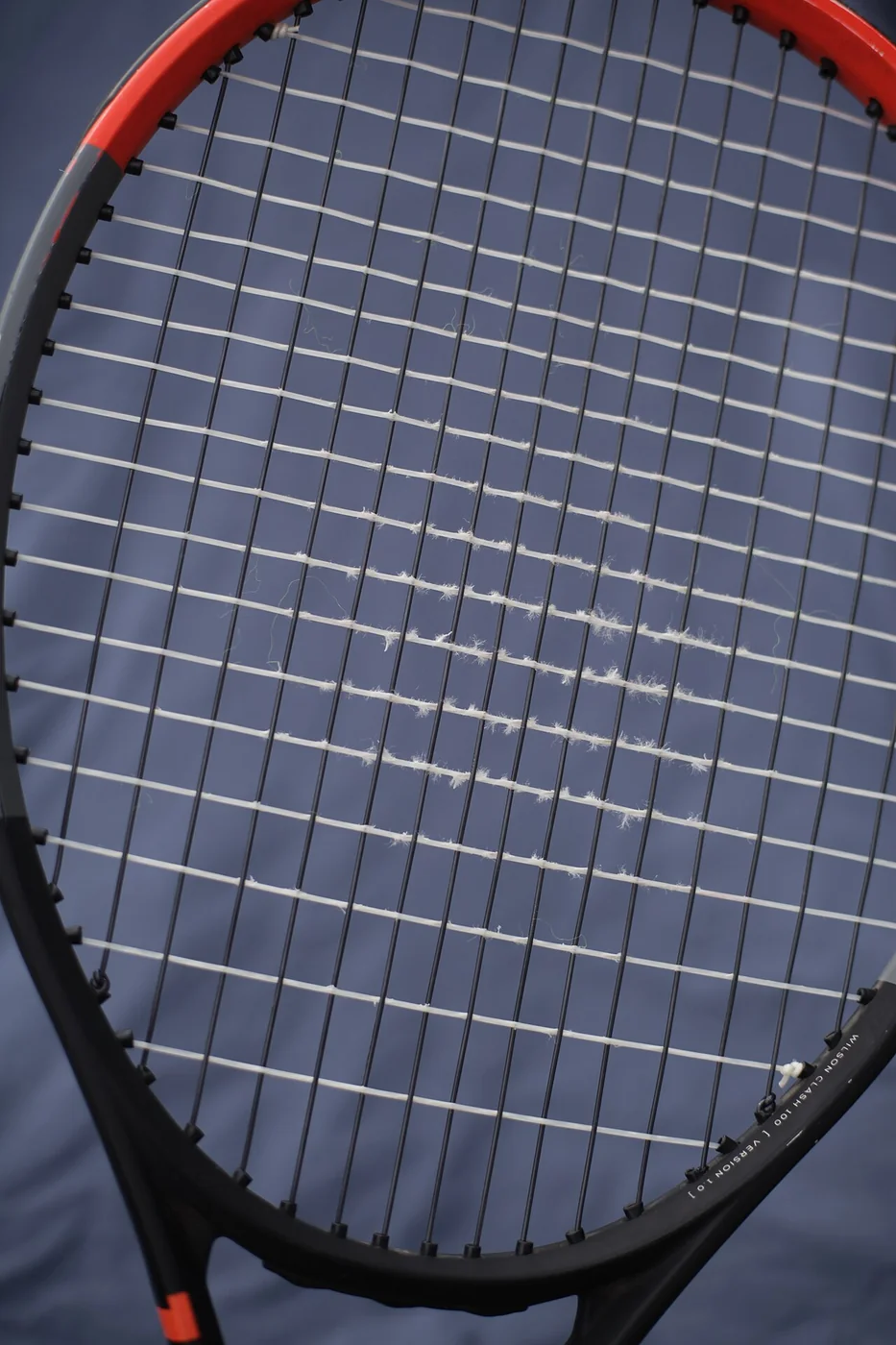
Visible fibres are a clue to condition, not a countdown to a precise replacement hour. Wear developing at central intersections and a recurring problem close to the frame lead to different next questions. In the latter case, the string path and protective parts deserve attention before judging the new material’s lifespan. Location gives the inspection somewhere useful to begin.
Checking grommets before installation helps avoid putting an expensive new string through an unresolved contact problem. Parnell also describes holding grommets in place during the job to protect the racket and string. If previous breaks repeatedly occurred close to the frame, mention that history first. A change to natural gut does not replace the need to deal with the path through which it runs.
A coating does not remove the wet conditions around it
The ITF describes a protective coating in natural-gut manufacture while still identifying wear and moisture resistance as limitations. Luxilon’s current product information also mentions a coating; that does not establish equal service life in every wet environment. If damp balls and outdoor conditions are frequent parts of your tennis, consider how much of that exposure you can reduce before making the purchase.
Playing with balls that stay wet, or leaving a racket beside damp towels in a bag, remains the same habit after a restring. Dry playing conditions where practical and separation from wet items are sensible starting points. For additional products or oils, use the care guidance for the exact string rather than borrowing an old remedy. An expensive material is not a reason to add an unverified treatment.
Someone playing mostly indoors and rarely breaking strings faces a different choice from someone moving between outdoor surfaces and changeable weather. The first can put the desired response at the centre of a trial. The second may prefer to keep the current multifilament or reserve a separate racket for suitable conditions. Buying natural gut need not become an obligation to maintain a setup that does not fit ordinary playing life.
Plan the finished job before dividing the packet
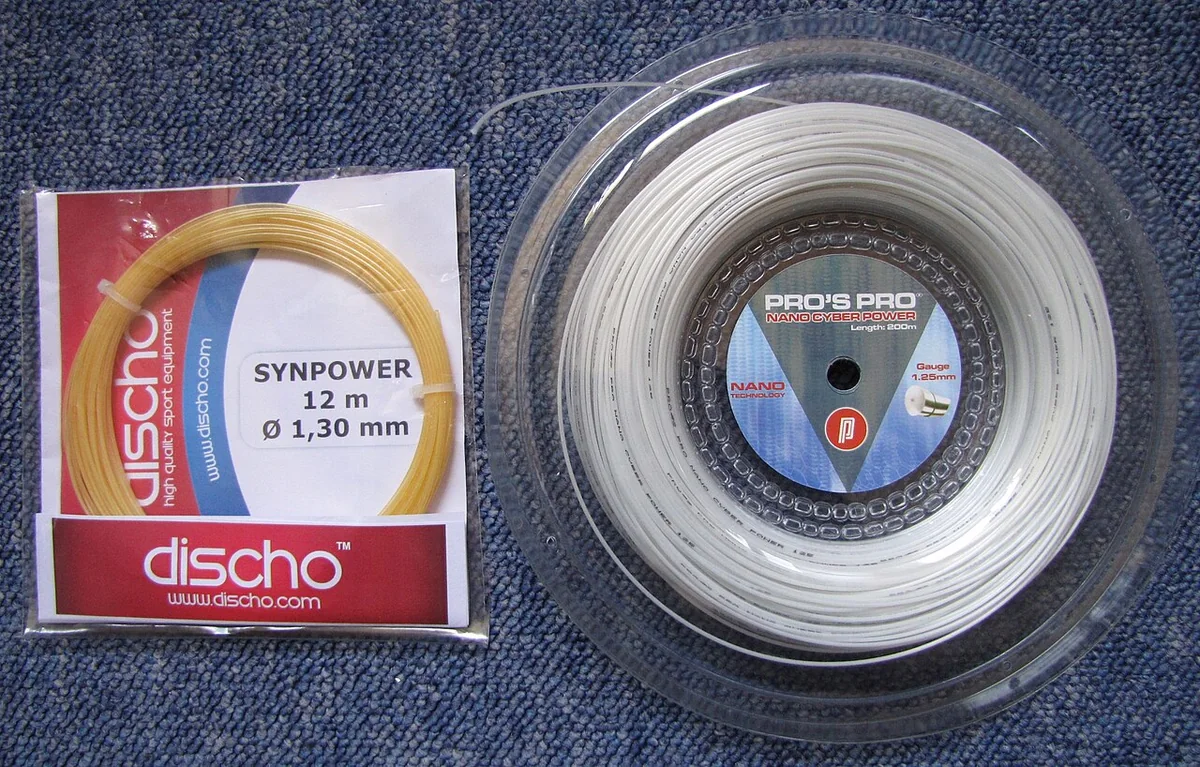
Touch VS 12M specifies the length in that particular set. It does not make every racket’s required length identical. The stringer needs a cutting plan appropriate to the pattern and method; with half sets, each separate piece must cover the mains or crosses assigned to it. A sufficient total on paper does not necessarily provide two pieces long enough for the intended job.
The purpose is more than minimizing leftovers. The first racket should be completed properly, and a successful setup should be straightforward to order again. Dividing several pieces or mixing products to economize before the first trial may leave usable stock while blurring the comparison you wanted. Start with one repeatable finished racket, then decide what it is worth repeating.
| Stage | Agree on | Why it matters |
|---|---|---|
| Before opening and installing | Product, diameter, length, handling of defects | Can the intended full bed be completed? |
| Before and during stringing | Frame and grommet checks; twists and friction | Are avoidable starting problems addressed? |
| After collection | Product-appropriate care and follow-up | Can initial condition and changes in use be separated? |
On court, move from your usual rallying into short returns and volleys, then attack balls for which you have time. Look for the response you wanted and for any repeated need to shorten the swing to keep the ball in. There is no requirement to endure an unsuitable response simply because the set was expensive. Distinguishing “never suited me” from “suited me, then changed” helps decide between another material and a fresh version of the same job.
For the next order, choose one natural-gut product as a candidate and obtain a full-bed quotation that includes material and frame checks. Agree on supplied-material handling and care after collection. If those conditions fit, try one racket; if they do not, or your present multifilament already does the job, keep the established setup. Choosing the service is part of choosing the string.
Sources and further reading
Keep reading
TENNIS TENSION LAB
Check your racquet’s tension today.
Get a high-precision tension reading in under 10 seconds. Tension Lab tracks changes from your first reading and helps you see when to restring.
- High-precision tension measurement. Ready in under 10 seconds.
- Track every change in feel. See the full story over time.
- Time to restring? Never leave it to guesswork.