Yonex PERCEPT 97 vs VCORE 98: choose depth and direction before a spin label
Both candidates can use spin. Compare the 2026 VCORE’s extra depth with PERCEPT placement through crosscourt-to-line changes and serving-to-returning transitions.

Choose between the Yonex PERCEPT 97 and VCORE 98 by asking whether you need more depth or more control of depth you already create. Try the 2026 VCORE 98 first for help in defense and crosscourt rallies; start with the PERCEPT 97 if your own swing supplies depth and you want to narrow your targets. The PERCEPT can generate spin too. Dividing the families into racquets for people who use spin and people who do not misses the useful decision.
Suppose your usual crosscourt ball works but the down-the-line change keeps going long. You may want additional spin, or you may need a response that lets you finish the same swing in the new direction. Conversely, if long errors are rare but you cannot push an opponent back, extra control may not be the first priority. Connect each family’s benefits to the situation in which you lose the ball.
VCORE PRO and VCORE belong to different product lines
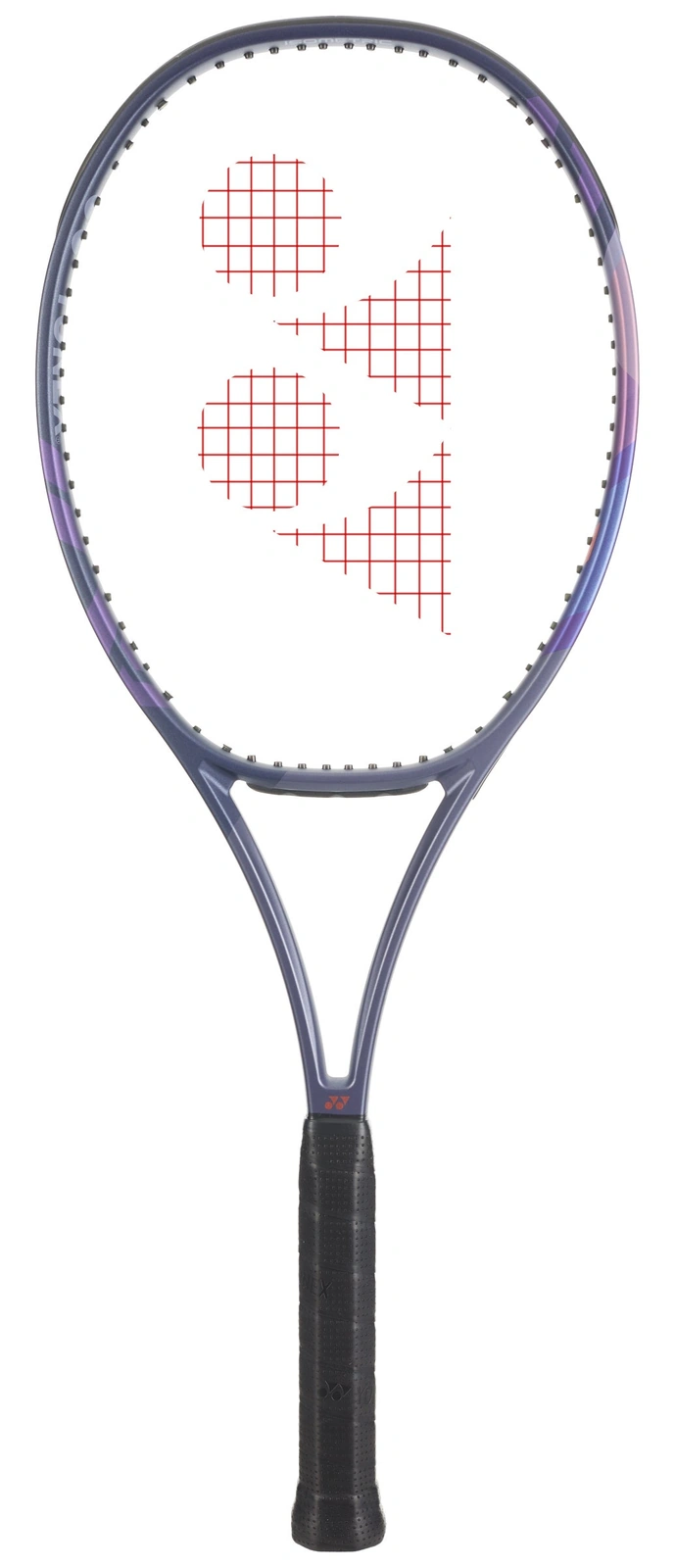
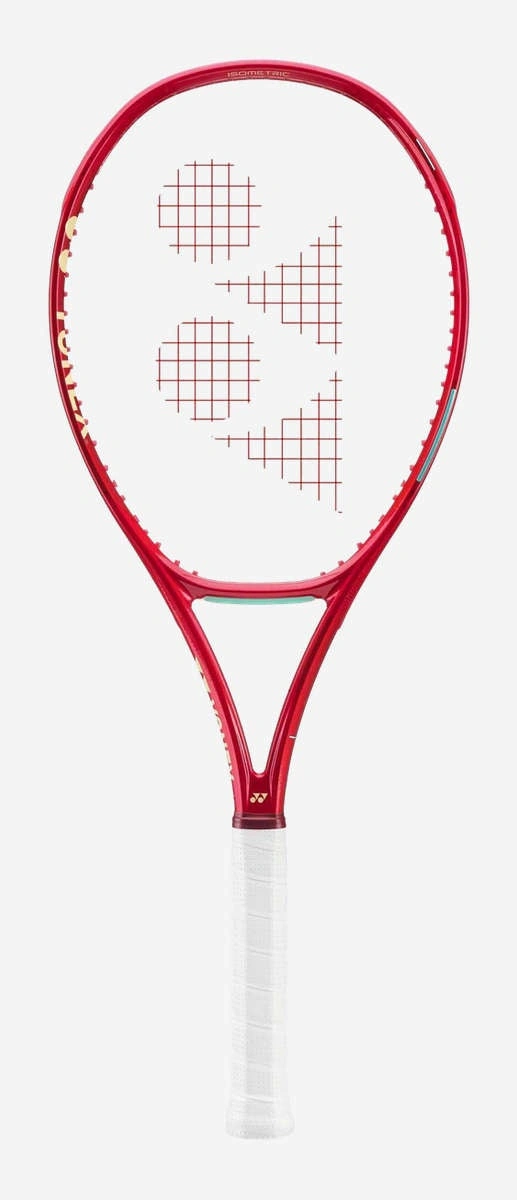
PERCEPT follows the control-oriented VCORE PRO family; VCORE is a separate spin-oriented family. The comparison here is the 310-gram, 16x19 PERCEPT 97 and the 305-gram, 16x19 VCORE 98 eighth generation. PERCEPT 97D and 97H, VCORE 98 TOUR and 98+ are separate candidates. Read the complete suffix before arranging a demo: a similar name can bring a different specification into the comparison.
| Specification | PERCEPT 97 | VCORE 98 eighth generation |
|---|---|---|
| Head size | 97 sq in | 98 sq in |
| Average unstrung weight | 310 g | 305 g |
| Average unstrung balance | 310 mm | 315 mm |
| Beam | 21–21–21 mm | 23–23.5–22 mm |
| Model code | 01PE97 | 08VC98 |
| Manufacturer tension range | 45–60 lb | 45–60 lb |
The PERCEPT weighs five grams more unstrung, yet Tennis Warehouse’s review swingweights are 315 for the PERCEPT and 321 for the VCORE. Static weight and rotational burden are ordered differently here. Those reference figures help frame questions about the actual demo, complete with strings and grip. Replace the assumption that the heavier product must be harder with a comparison of how naturally each follows your preparation.
The current PERCEPT 97 Midnight Navy is described by the retailer as a new cosmetic with the same specifications and playability as the standard model. Distinguish the olive-colored frame in 2023 reviews from the navy version without expecting a performance change from paint. For the VCORE, establish that it is the 2026 eighth generation. Mixing the previous generation, current 98 and heavier TOUR can make reports of height and power appear contradictory.
Choosing PERCEPT control does not require giving up spin
In Tennis Warehouse’s 2023 PERCEPT 97 review, Chris praised its consistency when taking a fast ball early and aiming at his intended target. Zsofi enjoyed the spin but wanted more support against heavier returns. Spin and placement coexisted, while stronger incoming balls remained a separate challenge. A smaller head is not a reason to flatten every stroke.
Start with the PERCEPT if you want to narrow the target while keeping the swing that already creates depth. Alternate a broad crosscourt area with a tighter target and observe whether you keep finishing the stroke. If a smaller target makes you guide every ball with the face, the control you expected has not yet translated into your own shot. The benefit appears when a committed swing stays within the intended area.
Defense must pass the same examination. Good placement with ample preparation is less helpful if a stretched ball repeatedly lands inside the service line. Can you create the necessary swing, and does doing so delay recovery? If reproducing the PERCEPT’s best contact requires a larger movement than you normally use every time, another candidate still deserves comparison.
Reassess VCORE depth when the direction changes
The2026 VCORE 98 review emphasized extra power and a higher launch. Brittany used them for depth; Michelle liked crosscourt shots but struggled with aggressive down-the-line changes. Kyla also preferred attacking second serves to returning faster firsts. Those observations turn depth into the beginning of the assessment, rather than its entire score.
The VCORE’s first task is to send a habitually short ball into a generous deep target. The next is to redirect a ball that already has enough depth without simply hitting harder. Passing only the first can mean easier defense but a smaller, restrained attacking swing. Run the tasks together to find whether the extra response provides useful margin or something you must continually suppress.
Changing direction requires choosing target width, depth and clearance together. After a comfortable crosscourt exchange, use a generous down-the-line target and see whether you can complete the swing at the same pace. Starting with a tiny area beside the line mixes the racquet response with a demanding aim. A buying demo should reveal a repeatable game, rather than reward the most difficult successful shot.

| Change you need | First candidate | What to assess | When another choice fits |
|---|---|---|---|
| More defensive and crosscourt depth | VCORE 98 | Direction changes after gaining depth | PERCEPT if fast incoming balls produce more long errors |
| Smaller targets with your own swing | PERCEPT 97 | Placement while finishing the stroke | VCORE if defensive depth demands excessive effort |
| Reliable first-serve returns | Compare both | Deep middle and attacking targets separately | Keep the current frame if only an occasional spectacular return improves |
| Spin serves followed by a ready first ball | Compare both | The rally after a second serve | Reconsider if a good kick is followed by consistently late preparation |
Spin and launch angle can change together without being the same thing
TWU’s string-pattern research explains that lateral string movement and recovery can affect both spin and rebound angle. It also separates incoming-ball, racquet and string conditions. A higher outgoing ball therefore does not measure spin by itself, and an identical 16x19 count does not establish an identical trajectory.
You can directly observe clearance, landing depth and directional spread during a demo. Without spin-measurement equipment, those outcomes are useful decision criteria. If the VCORE adds height and depth but widens directional errors, avoid rolling all three into one improvement. If the PERCEPT narrows the target but shortens the ball, that too is a combination of benefit and cost.
Yonex describes changes to the new VCORE’s upper frame and grommet structure as ways to expand contact margin and string movement. Its official introduction connects the current product family to that design direction. Turn the claim into two practical questions: does a high defensive ball now reach useful depth, and can you return to a lower, narrower target when the incoming ball is comfortable?
After a good serving session, start again as the returner
Ending a demo with serves can allow one favorite delivery to dominate the verdict. Both candidates have been positively reviewed for spin serves, but a service game is followed by a return game. Put the benefit of your first serve and the error against an opponent’s fast ball in the same session. A racquet that improves serving alone may differ from one that makes a whole set manageable.
Begin returns with a deep middle target, then try a generous attacking area. Even if you like VCORE depth, a longer preparation used to add spin can consume time against a fast serve. Even if the PERCEPT prepares quickly, a short return can give the server the next attack. Keeping contact and swing workable while changing targets remains the common question.

45–60 lb is a manufacturer range, not a shared starting prescription
The manufacturer specifications for both models list 45–60 lb. A shared range does not establish the same response at the same setting. Start with a familiar string and gauge in comparable condition where possible. If your current successful reference tension sits within both models’ instructions, discuss it with the stringer as an initial reference; there is no reason to make the midpoint the answer for everyone.
If the VCORE sends balls long, avoid immediately combining the firmest string with a higher tension. Identify whether the problem appears on short-ball attacks, late contact or every shot. Likewise, separate string response from preparation when the PERCEPT leaves balls short. Changing one element at the next job retains a link to the earlier response. Making both frame and string unfamiliar at once can obscure the benefit that prompted the purchase.
Assign added mass to a remaining problem after choosing a base model. A small adjustment may be worth comparing if the PERCEPT’s acceleration works but support is missing only against heavy balls. Do not add weight to a lively VCORE simply to slow your swing. It also affects preparation and recovery, potentially adding a cost somewhere other than the source of the directional error. Matching the two racquets numerically is not the objective.
Begin the next demo with a deep crosscourt ball followed by a direction change. Does the VCORE simplify the first while preserving the second target? Does the PERCEPT build confidence in the second without taking depth from the first? Then revisit that decision through serving and returning. If neither candidate retains both benefits, keep the current setup and narrow the problem before buying.
Sources and further reading
- Yonex UK — PERCEPT 97
- Yonex USA — VCORE 98
- Yonex Japan — 2026 Tennis / Soft Tennis catalog: VCORE 98 and PERCEPT 97
- Yonex USA — New VCORE Racquet Series: Spin Access Granted
- Tennis Warehouse — Yonex VCORE 98 2026 Review
- Tennis Warehouse — Yonex Percept 97 Racquet Review
- Tennis Warehouse — Yonex Percept 97 Midnight Navy
- Tennis Warehouse University / Rod Cross and Crawford Lindsey — String Patterns and Spin
TENNIS TENSION LAB
Check your racquet’s tension today.
Get a high-precision tension reading in under 10 seconds. Tension Lab tracks changes from your first reading and helps you see when to restring.
- High-precision tension measurement. Ready in under 10 seconds.
- Track every change in feel. See the full story over time.
- Time to restring? Never leave it to guesswork.