Ben Shelton: turning a big serve into wins on three surfaces
Six break points saved in one clay-court game, four three-set wins on grass, then a set-perfect Canadian campaign. Shelton’s range includes different ways to win—and the work of starting again.

Ben Shelton broke serve to open the 2026 Munich final, then immediately had to defend his advantage. The ATP match report records six break points saved in his first service game. That early struggle captures the work behind his growing range: a powerful start only becomes a foundation for victory if he can survive the response.
Shelton won on Munich clay, Stuttgart grass and the hard courts of Dallas and Montreal in 2026. The question connecting those trophies is how well holding serve creates opportunities to attack someone else's—and whether he can repeat the process in his next match. With a first major final followed by another defeat in Shanghai, that connection offers a useful way to see both his progress and the work still ahead.
Six break points belonged to one Munich game
All six break points he faced in the April 19 final against Flavio Cobolli came in that opening service game. He faced none thereafter, winning 6–2, 7–5. Six threats concentrated in one early game tell a different story from six scattered through an afternoon. Having escaped the first difficult passage, Shelton stopped offering Cobolli the same opening.
The second set introduced a different pressure. Serving at 4–5, Shelton recovered from 0–30, then broke in a game featuring a Cobolli double fault. A comfortable opening set had not removed the need to withstand a response. Afterwards, Shelton identified maintaining his own standard as his opponent improved as the difficult part of the contest.
That is a more revealing way to understand this clay title than simply saying his serve worked on a slower surface. He first had to turn a vulnerable 4–5 position into 5–5, preserving his chance to decide matters on return. Attacking and waiting were successive jobs dictated by the score. The opportunity to push forward depended on surviving the preceding service game.
Munich was familiar territory. Shelton had reached the 2025 final and lost to Alexander Zverev; his first tour title on clay had already arrived in Houston in 2024. The 2026 trophy therefore answered more than whether he could produce one successful week on the surface. He returned to a final and, this time, held his level through an opponent's attempt to change the match.

Melbourne made the definition of progress harder
Shelton had been discussing a different relationship with his serve before the season began. In remarks carried by the Australian Open website in November 2025, he described new confidence in running service games using only second serves. That was his own assessment. Its practical expression is something spectators can watch: the exchange after a first-serve miss, and his response when a return comes back deep.
The aim is not to diminish his first serve. It can provide cheap points without providing every point. When a return comes back, sustaining an advantage requires another decision and another shot. Watching the depth of that return alongside the outcome of the next exchange reveals a part of service-game construction that an ace total leaves out.
More options, however, do not automatically unsettle an elite opponent. Shelton lost his January Australian Open quarterfinal to Jannik Sinner 3–6, 4–6, 4–6. The tournament report noted his improved net play and greater variety, while Shelton felt he had maintained his level longer than a year earlier. He also acknowledged that he had not disrupted Sinner's rhythm as much as he wanted.
There are two standards of progress here. One is retaining your own level through an unfavourable passage; the other is forcing an opponent to change a comfortable pattern. Improvement in the first can coexist with a straightforward-looking defeat if the second remains difficult. With Shelton, the useful follow-up to noticing a new option is asking whether it changes the answer coming from across the net.
Munich supplied a different answer against a different player on a different surface. Shelton absorbed Cobolli's response and used his return opportunities. That did not erase the Sinner defeat. It added a concrete example of the conditions under which maintaining his level could turn into a win. Reading those results together gives a richer picture than treating development as the length of a winning streak.
On grass, waiting made the decisive break possible
His Stuttgart title in June was hard-earned. Shelton won all four matches in three sets. The tournament's account also records one match point saved against Marcos Giron in the last 16 and two against Jiri Lehecka in the semifinal. For a player whose serve seems an obvious asset on grass, his first title there involved repeated escapes from the edge of elimination.
The final against Taylor Fritz finished 6–4, 2–6, 6–4. After protecting the opening set and losing the second heavily, Shelton faced two break points while serving at 2–3 in the decider. He held for 3–3, then broke Fritz at 4–4. The player who had first been in danger turned a later opening into the decisive move.
The games before that opening matter. To settle a set with a single break, a player must first keep his own side of the score intact. An attacking highlight every game is less necessary than remaining close enough to use the next chance while an opponent is playing well. In Stuttgart, Shelton demonstrated that sequence: stay within reach, then make the return opportunity count.
In the winner's interview reported by the University of Florida, Shelton spoke about both exhaustion after a demanding week and confidence from beating strong grass-court opponents. The trophy and the workload belonged to the same experience. His first grass title was evidence of a way through unfamiliar pressure, rather than a universal answer for every future match on the surface.
Dallas, Munich and Stuttgart do not suggest three entirely different players. The big serve remained a base, with resistance under pressure and opportunity-taking on return built around it. What changed was the point in a match at which each task became urgent. A useful viewing habit therefore combines the surface with the movement of the score, instead of letting the court's reputation explain everything.
Montreal joined secure serving to productive returning
Montreal in August brought a smoother week. Shelton defended the Canadian Masters title with six wins and no sets lost. The 2025 event had been in Toronto, so the city changed while his winning run at the Canadian tournament grew to 12 matches. The result added successful repetition a year later to his ability to survive an individual week.
The previous Canadian campaign had required several three-set victories, including the final against Karen Khachanov. Going through the next edition without dropping a set showed a different route to the same trophy. Opponents and draws changed too, but the comparison remains useful: identical title counts can conceal very different amounts of rebuilding during a tournament. The story sits between the two winner's photographs.
He beat Brandon Nakashima 6–3, 7–6(4) in the Montreal final. Two figures supported by the ATP report and the match statistics explain its balance: no break points faced, and two of four break points converted. Protecting his serve and making something happen on return worked together. Neither half of the score had to carry the entire match.
The ATP account describes a return winner producing the first break at 3–3. Place that alongside Munich and Stuttgart and the significance of Shelton's serve expands. Keeping his own games secure allows one successful return game to change a set. Its value includes the direct points it supplies and the position from which he can wait for, then attack, an opponent's service game.
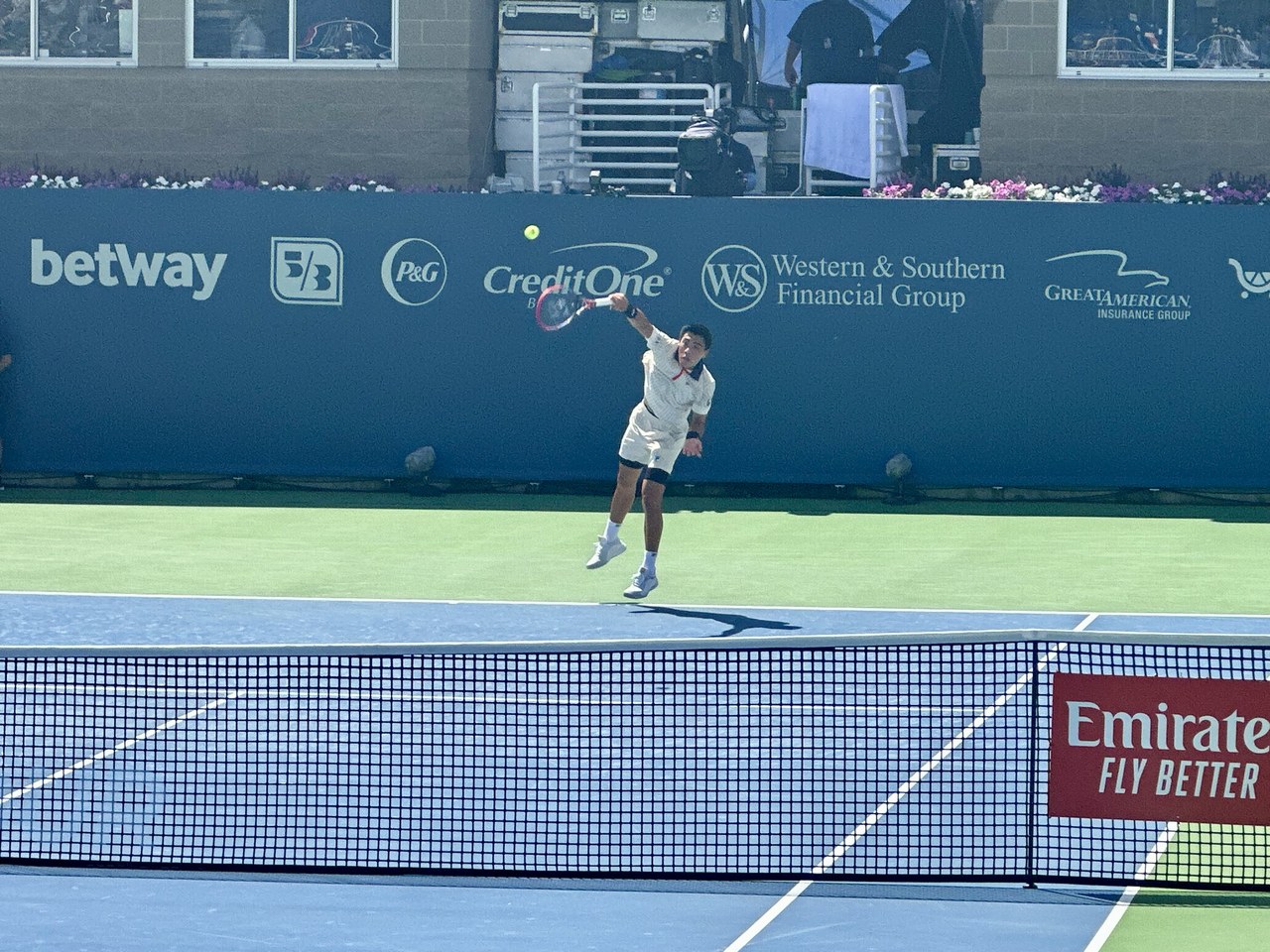
Afterwards, Shelton discussed his movement, ball-striking, serve and return together, describing an all-court performance. That is a broader focus than celebrating one weapon. In highlights, a viewer can begin with who gains a favourable position after the return, rather than following only the finishing winner. Tennis TV's official Montreal final highlights provide a companion to that viewing question.
An unbeaten set record in one tournament should not be confused with a solution against every opponent. Montreal's lack of danger and Stuttgart's repeated recoveries are valuable in different ways. One shows a high level sustained through a week; the other shows the ability to remain in contention when that level fluctuates. Further progress means producing the first kind of week more often while retaining the second route to survival.
Winning was followed by the task of starting again
The connection did not immediately extend into the following week. In a September US Open feature, father and coach Bryan Shelton recalled the Cincinnati opening loss to Jaime Faria after the Montreal title. Getting through the first match after a major success became a fresh problem for the team. Starting again after achievement was part of managing competition too.
Bryan said a subsequent conversation with Rafael Nadal underlined the importance of getting through that opening match and earning time to recover. The interesting part is its modest sequence. It is advice about remaining in the tournament long enough to find better tennis again, not a secret for overwhelming the next opponent. A title finishes one demanding task and is followed by another difficult beginning.

During his run to a first major final in New York, Shelton identified service-game construction, returning, baseline stability and sustained concentration as areas that had improved together. Those are ways of managing a whole match, rather than correcting one isolated stroke. They also fit the team's reflection on Cincinnati: a good point, set or tournament does not automatically reproduce itself at the next scale.
| Event | Result | What to watch |
|---|---|---|
| January, AO quarterfinal | Lost to Sinner 3–6, 4–6, 4–6 | Did retaining his level alter the opponent’s rhythm? |
| April, Munich final | Beat Cobolli 6–2, 7–5 | Did serving settle after the early danger? |
| June, Stuttgart final | Beat Fritz 6–4, 2–6, 6–4 | Did he stay close until a return chance arrived? |
| August, Montreal final | Beat Nakashima 6–3, 7–6(4) | Did secure serving and successful returning connect? |
| October, Shanghai third round | Lost to Gea 6–7(5), 6–7(3) | Did the advantage survive the passage after a break? |
On October 11 in Shanghai, Arthur Gea beat him in two tie-breaks. The tournament report records Gea losing serve at 5–4 in the first set before taking the breaker, then recovering after being broken at 3–3 in the second. Shelton created openings but could not carry the advantage to the end of either set. That later result leaves his development as a live question.
Watch three moments in Shelton's next match as parts of one sequence: how he protects a service game when the first delivery has not settled the point, whether a return opportunity actually changes the score, and how he begins again after a break or a major win. The speed display will still draw attention. The scenes that follow it will tell us whether the progress behind titles on three surfaces can keep repeating on bigger stages.
Sources and further reading
- Australian Open / Jackson Mansell — Same, but different: Shelton beaten but better at AO2026
- ATP / Sam Jacot, NittoATPFinals — Shelton wins Munich title
- Tennis.com / Florian Heer — Munich champ Ben Shelton: I have big ambitions on clay
- BOSS OPEN / emotion sports — Ben Shelton becomes the new BOSS at the Weissenhof
- Florida Gators / Kendall Merriett — Ben Shelton Claims Third Title of the Year at the ATP250 Boss Open
- beIN SPORTS — Shelton holds off Fritz to clinch Stuttgart title
- ATP / Vishakha Khandelwal, NittoATPFinals — Shelton wins Montreal, joins Murray, Djokovic & Nadal in Canada history
- Australian Open / Vivienne Christie — Making a statement: Shelton doubles down in Canada
- Tennis.com — Shelton v Nakashima: Montreal final statistics
- US Open / Chris Oddo — Ben Shelton closes in on history at2026USOpen:From ecstasy to serenity
- Rolex Shanghai Masters / ATP Staff — Gea upsets Shelton in Shanghai R3
- Australian Open / Bede Briscomb — Why Ben Shelton will win Australian Open2026
Keep reading
Players

TENNIS TENSION LAB
Check your racquet’s tension today.
Get a high-precision tension reading in under 10 seconds. Tension Lab tracks changes from your first reading and helps you see when to restring.
- High-precision tension measurement. Ready in under 10 seconds.
- Track every change in feel. See the full story over time.
- Time to restring? Never leave it to guesswork.