Flavio Cobolli’s next step: finishing from in front
The chase stood out in 2023. By 2026, what he did with his own lead had become the more revealing question. Serve and first shot offer a concrete place to look.

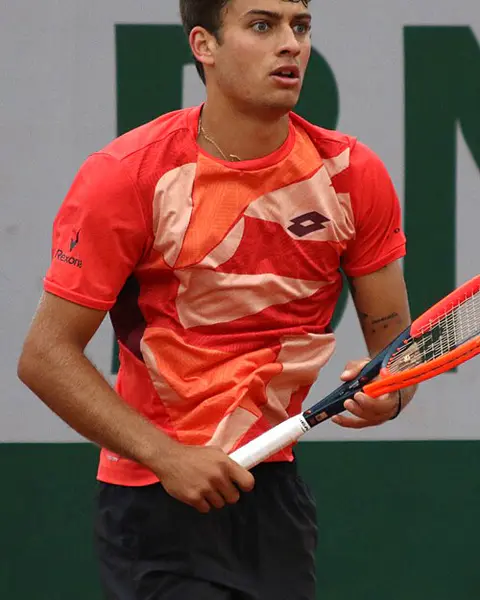
At 5–1 in the fourth set of his 2026 Roland-Garros fourth-round match, Flavio Cobolli had almost reached the quarter-finals. Almost proved a substantial distance. He lost both opportunities to serve out the match and eventually needed a tie-break to advance. The attacking game that had built his lead and the game required to finish the job were suddenly different problems.
That distinction remains useful as he approaches the late-October indoor swing. A season containing a first major final has also brought opening-match defeats in Beijing and Shanghai. Vienna lists him among its 2026 entrants. The next question is more revealing than whether he can produce another spectacular forehand: can he keep constructing his attacks when the score gives him something to protect?
Getting through the door used to be the ambition
In May 2023, Cobolli was ranked No.159 and still trying to reach a Grand Slam main draw for the first time. In a Roland-Garros interview during qualifying, he described that ambition as a dream. While contemporaries including Carlos Alcaraz, Holger Rune and Lorenzo Musetti had moved ahead, his immediate ranking target was the top 100. The same tournament meant different things to players of the same generation.
His main-draw debut ended in a 6–0, 6–2, 7–5 loss to Alcaraz. There was, however, a forceful interruption to the expected finish: from 3–5 and 0/40 in the third set, Cobolli escaped three match points and reached 5–5. The tournament report described an attacking surge. He could trouble an elite opponent before he could control a complete match against one.

An attacker chasing a deficit has an obvious reason to take risks. A player protecting a lead has a different temptation: preserve what is already there. The stroke may look familiar while the decision behind it changes. Cobolli's development has made that second situation increasingly important. He is no longer merely an interesting challenger whose best passage of play is the story.
On a first major appearance, a few games that inconvenience the world’s best can represent progress. Returning as a high seed brings a different expectation: those games should become repeatable foundations. Opponents, meanwhile, can wait for hesitation near the finish. The task has moved from demonstrating potential to completing wins.
Hamburg supplies a valuable counterexample
The 2025 Hamburg final prevents that argument becoming a simple story about a player who cannot finish. Cobolli beat Andrey Rublev 6–2, 6–4 for his first ATP 500 title. In the last service game he faced two break points, saved both and converted his first match point, according to the tournament's report. He had already closed a significant final before the difficult finish in Paris the following year.
That is the useful comparison. Pressure could coexist with successful execution. The question was not whether nerves ever appeared, but whether Cobolli could play the points needed after they did. Set beside the Roland-Garros fourth round, Hamburg shows why closing ability is better examined through situations than treated as a permanent character label.
For a season-long observer, an earlier success is a reference point. It makes it possible to ask how often the same standard returns against different opponents and on larger stages. A trophy does not remove the next difficult service game; it gives the player, and the viewer, another example against which to assess it.
Paris separated shot production from match completion
In the third round of Roland-Garros 2026, Cobolli beat Learner Tien 6–2, 6–2, 6–3. Tien arrived on a six-match winning streak that included the Geneva clay title and had won their previous meeting. This was a meaningful interruption of an opponent's momentum, not simply an expected win over someone struggling for form.
The next round exposed a different challenge. Cobolli's four-set victory over Zachary Svajda contained 57 winners, including 41 forehands, in the tournament report's count. It also contained that fourth-set lead slipping away. Both belong in an assessment of the match. A compilation of the winners alone would conceal the work still needed to turn the advantage into a handshake.
These numbers are useful within that match. They identify the gap between producing attacking points and reproducing the right choices near the finish. An attacking player's alternative is not always defensive tennis. Sometimes the real choice is between creating a favourable contact position and trying to end a point from an unfavourable one.
That makes the ball before the forehand worth watching. Did the serve create a short reply, or is the player manufacturing an attack from a deep return? The direction of the eventual shot may be identical, yet the demands differ. Looking only at how hard the ball travels misses the preparation that made the attack available.
Two days later, the quarter-final against Felix Auger-Aliassime supplied a useful comparison. Cobolli lost the first set and trailed 1–3 in the second before winning 4–6, 6–4, 6–4, 6–4. Afterwards, he identified his serve and first shot as strengths of the last game. That was a concrete account of finishing, contrasting with the uncomfortable close to the previous round.
Serve and first shot offer more observable criteria than a claim that a player has simply become braver. A viewer can examine where the first groundstroke is contacted, what space it creates and whether the next ball remains manageable. Confidence inferred from a face or a fist pump is a much less precise comparison.
A first attack can win the point immediately or leave a second attack available. Aiming at the smallest opening on every ball can turn a good start into a difficult demand. Keeping the opponent displaced while preparing again may preserve control even when the first attack returns. The connection between shots matters as much as the clean finish.
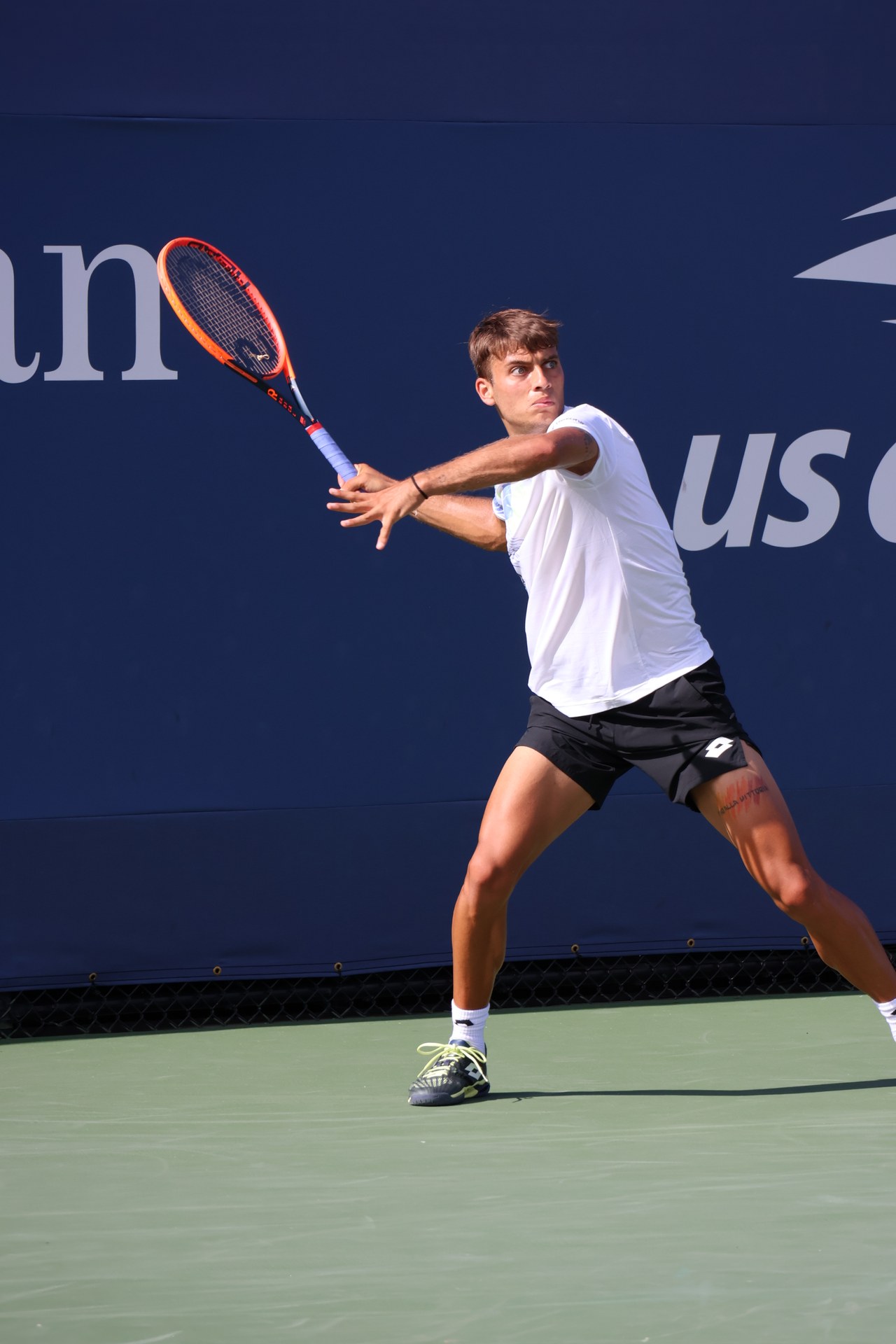
It also helps to separate a good decision from a successful result. A well-prepared attack can miss; a desperate swing can land. Selecting only the successful shot makes it easy to announce maturity one day and its disappearance the next. Repeating an appropriate choice in a comparable situation is a more useful measure of development.
| Stage | Verified result | Question to watch |
|---|---|---|
| 2023 Paris main-draw debut | Straight-sets loss to Alcaraz | How long can the attacking chase last? |
| 2026 Paris fourth round | Won a tie-break after leading 5–1 in set four | Does the choice change when protecting a lead? |
| 2026 Paris quarter-final | Four-set win over Auger-Aliassime | Do serve and first shot help finish? |
| 2026 Paris final | Five-set loss to Zverev | Can he restart after recovering a set? |
| 2026 Shanghai opener | Three-set loss to Mannarino | Can he connect his attacks from the start? |
Reaching the final created another starting point
Against Alexander Zverev in the final, Cobolli won the fourth-set tie-break but lost the match 1–6, 6–4, 4–6, 7–6(5), 1–6. The recovery resists a blanket description of a player overwhelmed by the occasion. The deciding set, equally, prevents that recovery being treated as a complete solution.
A five-set match asks its questions repeatedly. Recovering after losing a set, beginning again after winning one and holding serve late in the contest require different resets. The louder the celebration of a comeback, the easier it is to overlook the new problem immediately following it. After Cobolli's fourth-set escape, an entire set still remained.
The official Roland-Garros final highlights provide an entry point to that occasion. For a closer reading of match management, place the score progression beside the spectacular shots. A winner struck while recovering a deficit answers a different question from one struck while defending a lead. Its place in the match gives the shot its meaning.
After the final, Cobolli expressed his intention to keep pursuing another opportunity. He treated his first major final as a beginning. That outlook accommodates achievement and unfinished work together. Higher expectations need not turn every later defeat into a verdict that his progress has reversed.
A breakthrough makes a convenient ending to a profile. The calendar supplies no such ending for the player. At the next tournament he starts another opening match. Ranking points remain on the record, but each service game starts again. The question becomes not only how high his best level reaches, but how regularly he can find it in an awkward contest.
Autumn changes the viewing question
On 9 October, Shanghai's official report recorded Cobolli's 1–6, 6–4, 3–6 opening loss to Adrian Mannarino, following an opening defeat in Beijing. Reaching the Paris final had not made early rounds routine. Which portion of a long season a viewer selects can strongly shape the description attached to the same player.

Two defeats alone cannot identify a deteriorating technique. A more productive approach is to revisit the distinction already visible in Paris: creating an attacking opportunity and maintaining it. That can reveal where a match is becoming difficult without treating its eventual result as an explanation of every point.
A bold return that creates a break chance and the service game that consolidates a lead are different passages. One gives the opponent a new problem. The other asks the attacker to keep preparing effectively after the opponent changes the answer. Both are needed to understand Cobolli's progress.
As checked on 20 October 2026, Cobolli appears on Vienna's official entry list. His opponent and individual match time depend on the published draw and order of play. For now, the worthwhile question concerns how he reconnects his game during the indoor swing, rather than a hypothetical matchup.
In his next match, follow one service game in which he has a chance to close a set from first point to last. Watch the position he earns for the shot after the serve, then the space and preparation left if that attack comes back. The next step may become visible in that sequence before it appears in another spectacular winner.
Sources and further reading
- Roland-Garros — Cobolli vows to get RG tattoo if he qualifies
- Roland-Garros — Alcaraz steers past gallant Cobolli
- Roland-Garros — Cobolli topples Tien to break new ground
- Roland-Garros — Cobolli holds nerve to reach last eight
- Roland-Garros — Cobolli sets all-Italian semifinal
- Roland-Garros — Zverev breaks Grand Slam duck in Paris
- Roland-Garros — Cobolli: It's only the start
- Rolex Shanghai Masters — Zverev survives tumble, Cobolli falls in Shanghai
- Erste Bank Open — Erste Bank Open: 2026 players to watch
- Hamburg Open — Cobolli wins the Bitpanda Hamburg Open
- Roland-Garros — Roland-Garros 2026 quarter-final: Auger-Aliassime–Cobolli
- Roland-Garros — Paris in pictures: Men’s final
- Hamburg Open — Hamburg Open champions
- Sky Sport — Cobolli ai quarti del Roland Garros: Svajda battuto in 4 set
Keep reading
TENNIS TENSION LAB
Check your racquet’s tension today.
Get a high-precision tension reading in under 10 seconds. Tension Lab tracks changes from your first reading and helps you see when to restring.
- High-precision tension measurement. Ready in under 10 seconds.
- Track every change in feel. See the full story over time.
- Time to restring? Never leave it to guesswork.