Learner Tien: adding attack without losing patience
The ability to stay in a rally now has more ways to end it. Practice, defeats against powerful opponents and a restart in a clay final reveal changes a collection of winners would miss.

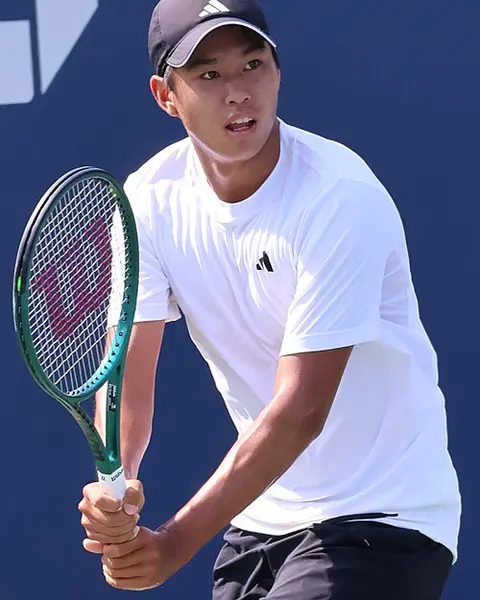
After Tommy Paul left a Houston practice court in late March 2026, Learner Tien stayed for another half-hour. Ed McGrogan of Tennis.com watched him work on groundstrokes, slices and drop shots, with Michael Chang offering calm advice. A player known for outlasting opponents was making time for different ways to change a rally.
Tien’s development is more interesting than a simple switch from defense to attack. He is keeping the connections that already work while becoming more selective about the balls to finish quickly and the exchanges to slow down. The useful question is whether his choices within a point have expanded. A long rally and a short drop shot can belong to the same match plan.
A first major quarterfinal and a first tour title on clay in 2026 tested those choices in different conditions. A heavy Indian Wells defeat and an October third-round exit in Shanghai belong to the story too. Late in the season, the point is not to draw a straight line upward. It is to ask which of the options visible on a good day survive a stronger opponent or a less familiar surface.
The first breakthrough showed how to keep a match alive
Tien qualified for the 2025 Australian Open before meeting Daniil Medvedev in the second round. A two-set lead became a fifth set, but Tien won the deciding tiebreak 10–7 after four hours and 49 minutes. Tennis.com’s report placed the finish just before 3 a.m. and described him taking the final four points.
The first quality visible in that route is the ability to start another point after an advantage disappears. Winning the opening sets cannot play the next return for you. When the opponent restores momentum, another opportunity must come through the present rally. That sort of survival helped create the defensive label attached to Tien.
But treating an extended match as entirely passive tennis erases the decisions that finish it. Staying in contention requires both the ability to return another ball and the ability to close an opening. Which skill a player uses most often is a different question from which has room to develop. Tien’s subsequent season kept making that distinction relevant.
Australian Open’s retrospective put his first full season at 36 wins from 60 matches. Metz brought his first tour title and the Next Gen ATP Finals brought a year-end trophy, after a final loss to Joao Fonseca there in 2024. The task had expanded beyond beating a famous opponent once: he was learning to win the last match of different tournaments.

The same opponent returned, but the victory took another shape
A year later in Melbourne, Tien beat Medvedev 6–4, 6–0, 6–3 to reach his first major quarterfinal. The tournament report highlighted high left-handed forehands, angles, forceful serves and drop shots. Its unforced-error count was 16 for Tien and 30 for Medvedev. Variety and restraint appeared together in one performance.
The contrast matters beyond five sets becoming three. Patience and attack took turns confronting the opponent. Moving someone with height before introducing a low or short ball adds a decision about contact and forward movement to the task of covering the court. Tien’s patience can help select an attacking opportunity, rather than merely postpone one.
Raising pace alone can give an opponent a more consistent rhythm. Changes of speed, height and length demand different replies even from similar court positions. For someone following Tien’s development, the useful lead-in to a winner is the ball that narrowed the opponent’s answers. The question is whether he has added ways to create a finish, as well as a finishing stroke.
| Stage | Verified outcome | Development task | What to follow |
|---|---|---|---|
| 2025 Australian Open | Five-set win over Medvedev | Restart after losing a lead | Finishing choices after long exchanges |
| Late 2025 | Metz and Next Gen titles | Repeat good tennis through a tournament | Basic patterns under closing pressure |
| 2026 Australian Open | Medvedev win; first major quarterfinal | Combine variety with restraint | Points shortened by the serve |
| 2026 Indian Wells | Saved match points; lost to Sinner in quarterfinal | Choose when to persist or press | The reply an attack gives the opponent |
| 2026 Geneva | Beat Navone for first clay title | Serve and lead management on another surface | Restart after being caught |
Chang’s influence includes how information is received
In Houston, Tien described compatible communication with Chang and encouragement that remained steady through wins and losses. At the Australian Open, he also credited his coach’s calm presence and help noticing things he had missed. His account of coaching included how advice reaches him, alongside the advice itself.
Expanding a repertoire also creates occasions to miss. Abandoning every drop-shot opportunity after one failure, or continuing to hit hard simply because an attacking plan has begun, would reduce the available choices. Consistent communication provides a basis for separating what was attempted from its outcome. Tien’s comments make the coaching relationship richer than a single answer delivered at the right moment.
Chang has experienced winning a major as a player; Tien is building a tour career of his own. Looking only for their similarities can obscure what today’s opponents and courts require. The more useful question is whether Tien gains new answers while retaining his own strengths, rather than whether he starts playing like Chang. Height, quicker serves and short balls can coexist within that development.

Zverev and Sinner exposed the boundaries of the added attack
Alexander Zverev stopped Tien in the Australian Open quarterfinal with 24 aces. The tournament report also described a big serve removing Tien’s fourth-set set point. Playing strong baseline tennis and recovering points that end before a substantial rally develops were different tasks.
An opponent’s strong first strike reduces the time in which an improved rally game can be used. Even a return that lands in does not necessarily create an equal start: a short, high reply can surrender the next attack. Tien’s next step therefore involves the starting position he creates after the opponent serves, as well as the pace of his own delivery.
Indian Wells produced another contrast in March. Tien saved two match points against Alejandro Davidovich Fokina and came back to reach the quarterfinals. He described feeling short of energy early, but staying close enough to give himself time to find a better rhythm. Learning more attacking options had left that older survival skill as valuable as ever.
The venue also held a familiar seat in the stands. After beating Shelton earlier in the tournament, Tien recalled exactly where he had sat as a child. He also explained his effort to give each point equal value, including the big ones. The memory of a special place sat beside a method for addressing the next ball.
Returning to a childhood venue can become a decorative detail in a victory story. Tien linked his approach to adapting to the match in front of him once play starts, rather than the opponent’s ranking. What can change on court is the return’s depth, the rally’s height or the ball selected for attack. The next two results also left execution problems that an outlook alone could not settle.
Sinner then beat him 6–1, 6–2. The tournament report counted 19 Tien forehand unforced errors, while Sinner said Tien had attacked early and he had responded by holding back. Increasing aggression had not automatically created a favorable exchange. The ball on which that aggression was used became central again.
Taken together, the outcomes make it hard to cast new attack and established patience as substitutes. Survival bought time on the day Tien saved match points; the next opponent demanded that his initiative withstand a different reply. The work after defeat should be more specific than simply attacking more or less: which heights and depths invite a change of direction, and which call for another ball?
The clay title required a restart after the lead disappeared
After the Houston practice came a new clay-court achievement in Geneva. On May 23, Tien beat Mariano Navone 3–6, 6–3, 7–5 for his first clay title and second ATP singles trophy. His first had come indoors in Metz the previous November. The title count contained two different surface problems.
Easy points were scarce early in the Geneva final. SRF reported that the first three games took 20 minutes and contained ten deuces; Navone went on to take the first set. Merely possessing more attacking strokes could not settle that start. Another service game still required decisions after the previous one had become a prolonged contest.
The tournament report described Tien serving more effectively in the final two sets. He led the decider 3–0, was caught at 3–3, then broke again at the end to win. Building a lead and closing a match after that lead disappears are demands made at different moments. He completed the second task as well as the first.

Transferring hard-court success to clay requires more than copying strokes. A ball of similar depth can leave different time for preparation and recovery, and one attack may fail to displace the opponent completely. Geneva showed Tien carrying his decisions through to a title on another surface. It still leaves the next clay match to ask its own questions.
Include Shanghai’s defeat to keep the next questions visible
On October 12, Tien lost 6–4, 7–6(3) to Casper Ruud in Shanghai’s third round. Even in a season containing a major quarterfinal and a clay title, a new opponent presented a new problem. Treating the loss as cancellation of all progress leaves only the score. Treating it as irrelevant because progress exists would hide conditions that still need attention.
The first question for his next match concerns an opponent returning comfortably. When his serve fails to provide an immediate advantage, can he recover his usual rally quality? The second arrives with an attacking opportunity. Of power, angle and moving forward, which choice leaves him favorably placed for the following ball? That connection shows how development is being used more clearly than a general aggression count.
The third question begins in the game after a lead vanishes. Can he retain useful serve and return targets, or choose another route as the opponent responds? Instead of relabeling Tien from defender to attacker, follow how freely he moves between the connections he already trusts and the finishes he is adding.
In the next match, follow one point in which Tien receives a short ball all the way through. After the first attack lands, ask what room remains when the opponent replies. The choices prepared in that extra Houston practice become more than a list of techniques in precisely that second decision.
Sources and further reading
- Australian Open / Bede Briscomb — Tien all grown up after mauling of Medvedev at AO2026
- Australian Open / Bede Briscomb — Fast Learner: Deep AO2026 run shows rate of Tien’s rise
- Australian Open / Dan Imhoff — Zverev halts Tien’s run at AO2026
- Tennis.com / Ed McGrogan — Learner Tien hopes to emulate Michael Chang’s clay success
- Tennis.com / David Kane — Learner Tien finds second gear at Indian Wells
- Tennis.com — Learner Tien remembers being a fan while beating Shelton
- BNP Paribas Open / Chris Oddo — Stoic Sinner Dismantles Tien To Reach Semis
- Gonet Geneva Open — A great champion
- SRF — Enger Finaltriumph: Tien holt sich seinen1.TurniersiegaufSand
- Rolex Shanghai Masters / Jerome Coombe — Jodar reaches Shanghai R4; Ruud defeats Tien
- Tennis.com / David Kane — Teenager Learner Tien schools Medvedev in late-night upset
- Australian Open — Learner Tien player profile
Keep reading
Players
TENNIS TENSION LAB
Check your racquet’s tension today.
Get a high-precision tension reading in under 10 seconds. Tension Lab tracks changes from your first reading and helps you see when to restring.
- High-precision tension measurement. Ready in under 10 seconds.
- Track every change in feel. See the full story over time.
- Time to restring? Never leave it to guesswork.