Vienna 2026: three matchups that put the defenders on the front foot
The interesting part is not always who keeps the rally alive. These three potential Vienna matchups turn on who earns the ball they can attack next.

When the Vienna draw appears, look for three possible pairings: Carlos Alcaraz against Daniil Medvedev, Medvedev against Learner Tien, and Alexander Zverev against Alex de Minaur. All involve players known for making opponents hit another ball. But the reason to watch is what happens when that extra ball becomes an invitation to attack. Earlier meetings in 2026 offer three different versions of that moment.
As of 22 October, these are a watchlist, not scheduled matches. All five players appear on the tournament’s published player list, while its draw page still shows no matches. The draw and subsequent results will determine whether any of these pairings happen. For now, they give you questions to carry into the opening rounds, rather than fixtures to put in your diary.
Alcaraz has a date; his match still needs a time
Vienna’s main draw runs from 26 October to 1 November. The organisers have announced that Alcaraz will play his opening match on Centre Court on Tuesday 27 October, his first appearance at the tournament since 2021. That does not make the programme’s opening time his match time. His opponent and place in the daily order of play still matter.
| Date | Programme | Vienna local time | Korea, KST |
|---|---|---|---|
| 24 Oct | Qualifying | 12:00 | 19:00 |
| 25 Oct | Qualifying | 13:00 | 21:00 |
| 26–27 Oct | First round | 13:30 | 21:30 |
| 28 Oct | First and second rounds | 13:30 | 21:30 |
| 29 Oct | Second round | 13:30 | 21:30 |
| 30 Oct | Quarterfinals | 13:30 | 21:30 |
| 31 Oct | Wheelchair singles final; men’s singles semifinals | 12:30 | 20:30 |
| 1 Nov | Singles and doubles finals | 11:30 | 19:30 |
Austria’s clocks go back on 25 October. Vienna is seven hours behind Korea on the first qualifying day and eight hours behind from the second. The final weekend also combines several events within each programme. Neither the Saturday nor Sunday opening time should be read as the exact start of the men’s singles match. Set a match-specific reminder once the order of play is out.
Alcaraz–Medvedev: can the returner keep the initiative?
Medvedev beat Alcaraz 6–3, 7–6(3) in the Indian Wells semifinal on 14 March. He recovered from 1–3 in the second set and saved two set points at 4–5. Those details suggest a match won by surviving danger. Yet the players’ accounts afterwards put equal weight on how often Medvedev created the pressure himself.
Medvedev described using a strong return as an opening to dictate the point. Against Alcaraz, he explained, leaving the ball short through the middle gives the Spaniard too many choices: a drop shot, a winner or an approach. The point was not to aim at one wing regardless of the situation. It was to send a ball that kept the next attacking decision within reach.
Alcaraz was struck by how much aggression came with so few errors. His second-set response included more height in the early exchanges, a more assertive return and more opportunities to move forward. That is an appealing contest within the contest: one player applying pressure, the other changing the shape of the exchange so he can make the next move.
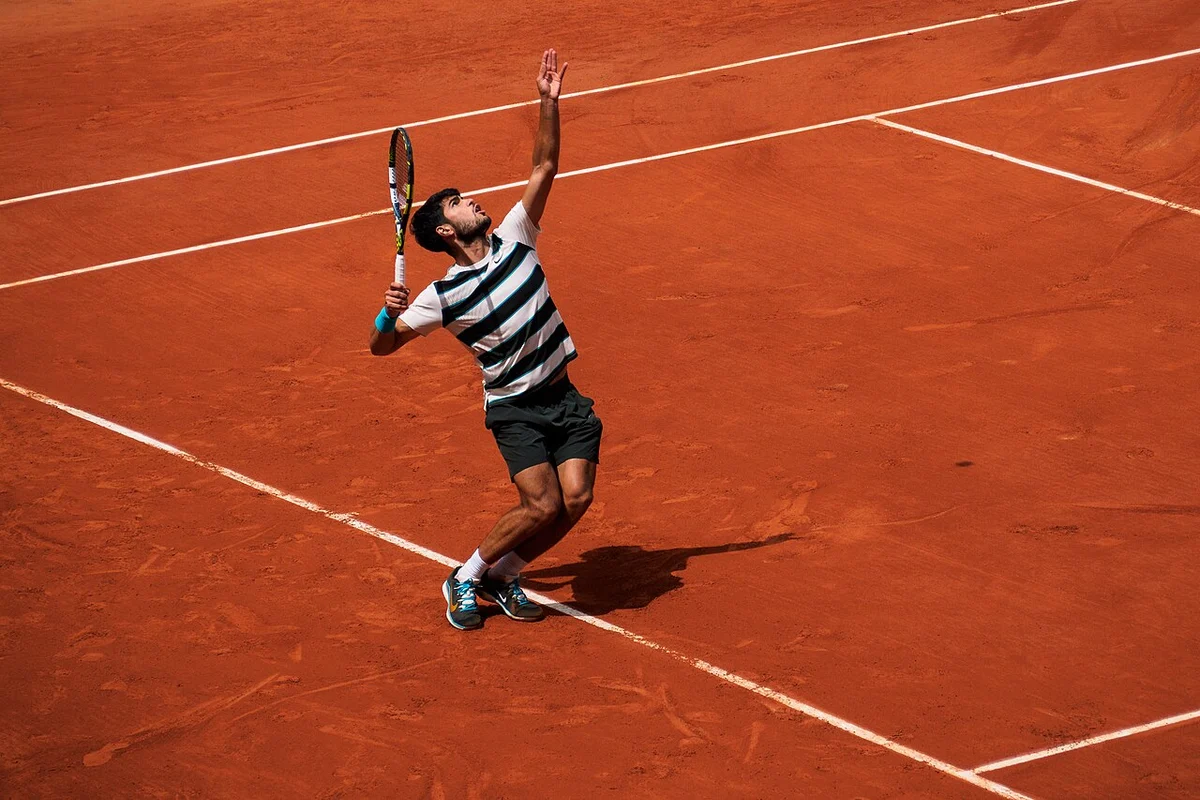
If they meet in Vienna, follow Medvedev’s return and his next contact as one sequence. A deep return has limited attacking value if he is immediately pushed back again. More revealing is whether a shorter reply lets him step in and stay in charge. For Alcaraz, watch what happens when his first attacking option is closed: can he rebuild height and depth, then enter the court on better terms?
Medvedev–Tien: patience can belong to the player taking charge
Tien offers Medvedev a different problem. In the Australian Open fourth round on 25 January, the American won 6–4, 6–0, 6–3. The tournament report counted 16 unforced errors for Tien and 30 for Medvedev. This was not simply a young player swinging harder and harder until an established defender finally gave way.
The Australian Open account highlighted Tien’s high, heavy left-handed forehand, his use of angles and his willingness to wait for an opening before accelerating. Drop shots added another change of pace. Medvedev said that even his good shots were met by better replies. Waiting and attacking were parts of the same construction, rather than competing descriptions of Tien’s tennis.
The useful viewing cue is the ball on which Tien stops waiting. Has he first moved Medvedev out of a comfortable hitting position, or is he trying to finish before he has earned the space? Watch, too, whether Medvedev’s depth keeps him behind the baseline. A long rally can contain several changes of control before anybody attempts the winner.

Melbourne supplies the question for a possible rematch, not a result to copy into a new draw. Look for the order in which Tien absorbs pace, changes the geometry and moves in. If that sequence appears early, even a lengthy baseline exchange becomes easier to read: someone is choosing the terms, not merely keeping the ball in play.
Zverev–De Minaur: a return opportunity still has to become a break
Zverev defeated De Minaur 6–4, 6–4 in the Shanghai quarterfinal on 15 October. He won 35 of the 44 points played behind his first serve, close to 80 per cent. That is the share of points won after a first serve landed, not the proportion of first serves he put in. The distinction matters when judging the task facing the returner.
De Minaur did create chances. Zverev saved three break points in the game that took him to 4–2 in the first set and two more when holding for 3–3 in the second. Five opportunities, concentrated in two games, separated pressure from a tangible change on the scoreboard. A Vienna rematch would put that gap back in view.
After De Minaur makes the return, locate his next contact. If he can prepare close to the baseline, his speed can begin to take time away from Zverev. If the next ball already has him stretched wide or retreating, getting the return in has bought a much narrower set of choices. For Zverev, the question is whether he can still take the first attacking step when his serve stops winning so many points outright or on favourable terms.
| Pairing | Follow this sequence | Earlier 2026 meeting |
|---|---|---|
| Alcaraz–Medvedev | Deep return, then Medvedev’s next contact | Indian Wells: Medvedev won 6–3, 7–6(3) |
| Medvedev–Tien | The ball on which Tien turns patience into attack | Australian Open: Tien won 6–4, 6–0, 6–3 |
| Zverev–De Minaur | Return position and the next ball at a break chance | Shanghai: Zverev won 6–4, 6–4 |
One tournament, different autumn stakes
In the ATP’s Race to Turin snapshot dated 19 October, Zverev and Alcaraz had already qualified for the Finals. Medvedev was sixth on 3,420 points and De Minaur tenth on 2,880. Those are dated, post-Shanghai figures; subsequent tournament results can change them. They explain why Vienna forms part of a qualification chase for some players while others arrive with a place already secured.
A secured Finals place does not remove the value of a title or a strong finish to the season. Nor does a lower Race position tell us that a player will automatically take more risks on court. Keep those two layers in view: the choices that create the next attacking ball, and the different consequences that a win has for each player’s autumn.
Once the draw is published, check where these pairings could occur, then use the daily order of play to choose your viewing window. If they never materialise, the questions still travel into the players’ opening matches: the return that limits Alcaraz’s choices, the ball that invites Tien forward, the position De Minaur earns after returning. Those details make the familiar labels of attacker and defender much less useful—and the tennis much more interesting.
Sources and further reading
- Erste Bank Open — Visitor info and Centre Court programme
- Erste Bank Open — Players 2026
- Erste Bank Open / ATP — Alcaraz returns to Vienna
- Erste Bank Open — Carlos Alcaraz kommt nach Wien
- Erste Bank Open — Singles draw
- BNP Paribas Open — Medvedev stuns Alcaraz
- BNP Paribas Open — Daniil Medvedev — March14 press conference
- BNP Paribas Open — Carlos Alcaraz — March14 press conference
- Australian Open — Tien all grown up after mauling of Medvedev at AO2026
- Rolex Shanghai Masters / ATP — Zverev defeats De Minaur in Shanghai quarterfinal
- Rolex Shanghai Masters / ATP — Live Race to Turin — 19October2026
Keep reading

TENNIS TENSION LAB
Check your racquet’s tension today.
Get a high-precision tension reading in under 10 seconds. Tension Lab tracks changes from your first reading and helps you see when to restring.
- High-precision tension measurement. Ready in under 10 seconds.
- Track every change in feel. See the full story over time.
- Time to restring? Never leave it to guesswork.