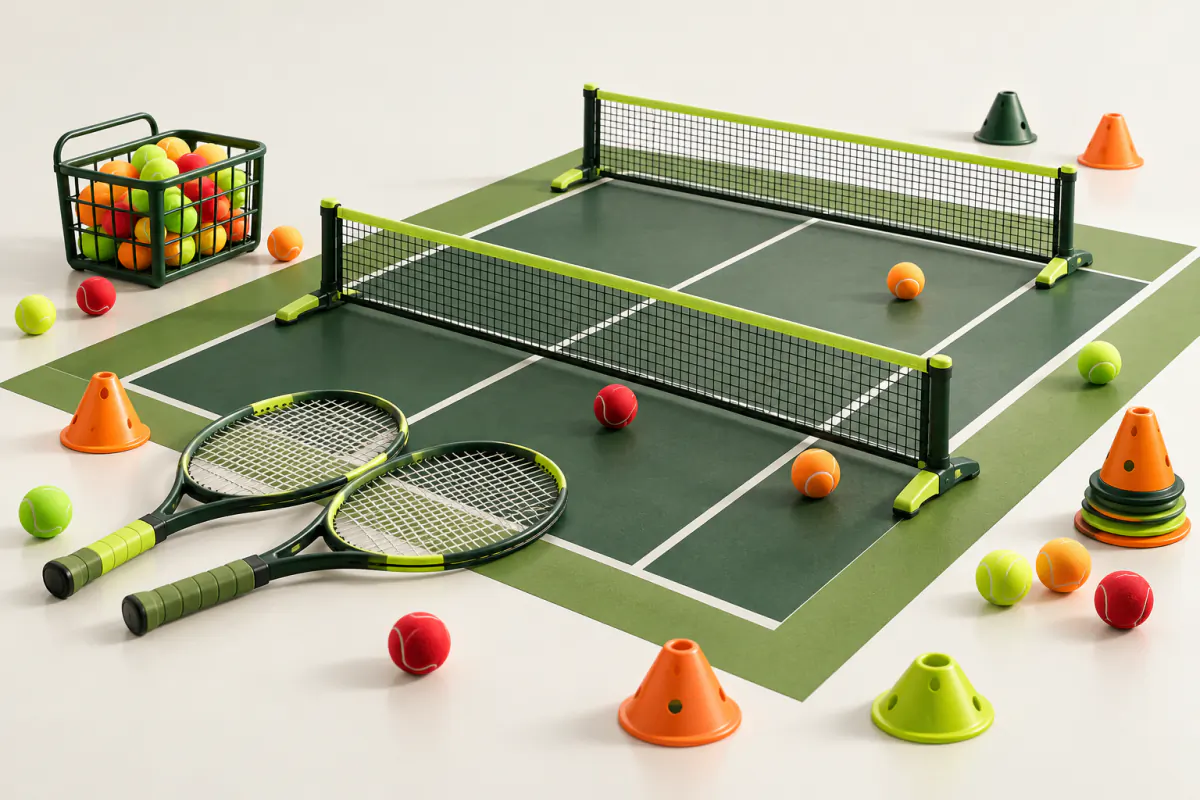
In Larson and Guggenheimer’s 2013 study, eight children aged seven to nine performed better forehands with low-compression balls on a scaled court. Their average velocity–precision–success score was 2.30, compared with 0.75 using a standard ball and court. The test rewarded placing the ball near a target, producing speed and keeping the shot in play during rallies with a coach.
Each child completed both conditions on separate days, 24 hours apart, with the order counterbalanced. The modified court was 18.3 m long and the standard court 23.8 m. Players attempted each of three patterns six times: four deep crosscourt shots followed by a deep down-the-line forehand; one deep down-the-line forehand; and a short-angle crosscourt forehand followed by a deep down-the-line shot.
Ball velocity averaged 6.5 km/h higher in the modified condition, alongside smaller placement errors. A lower bounce and less distance to cover can give a child more time to organize contact. Slowing the incoming game can therefore help a player strike more freely. Because this short comparison changed both ball and court for eight children, isolating either component and assessing long-term learning requires further evidence.
Hammond and Smith’s 2006 study followed a different question: how skills changed during eight weeks of coaching. Fourteen beginners aged five to eleven completed forehand, backhand and serve assessments in the first and last weeks, with weekly one-hour lessons between them. Mean total-score improvement was 11.33 points for the low-compression group and 7.88 for the standard-ball group; the between-group difference was statistically nonsignificant.
The groups also began with different profiles. Mean age was 6.67 years in the low-compression group and 9.38 in the standard-ball group, with previous coaching experience averaging 0.50 and 1.06 years respectively. Coaches reported easier teaching of waist-height contact and a low-to-high swing with the softer ball, as well as longer rallies. Those observations describe the teaching experience alongside the measured skill scores.
A 2016 systematic review covered 25 studies involving 989 children across sports. Five studies followed learning over a period of practice, and the longest intervention lasted eight weeks. A practical progression proposed here is to record target hits out of ten and the longest rally using a fixed ball and distance. Repeat the task at the beginning of the next lesson. Once performance is stable, increase the distance slightly and record it again. This provides a record of immediate success, later repeatability and adaptation to a harder task.