Four players, one court: plan six matches before settling the group
Write down the format and ranking rules before the first ball. The final match should complete the table, not invent its rules.
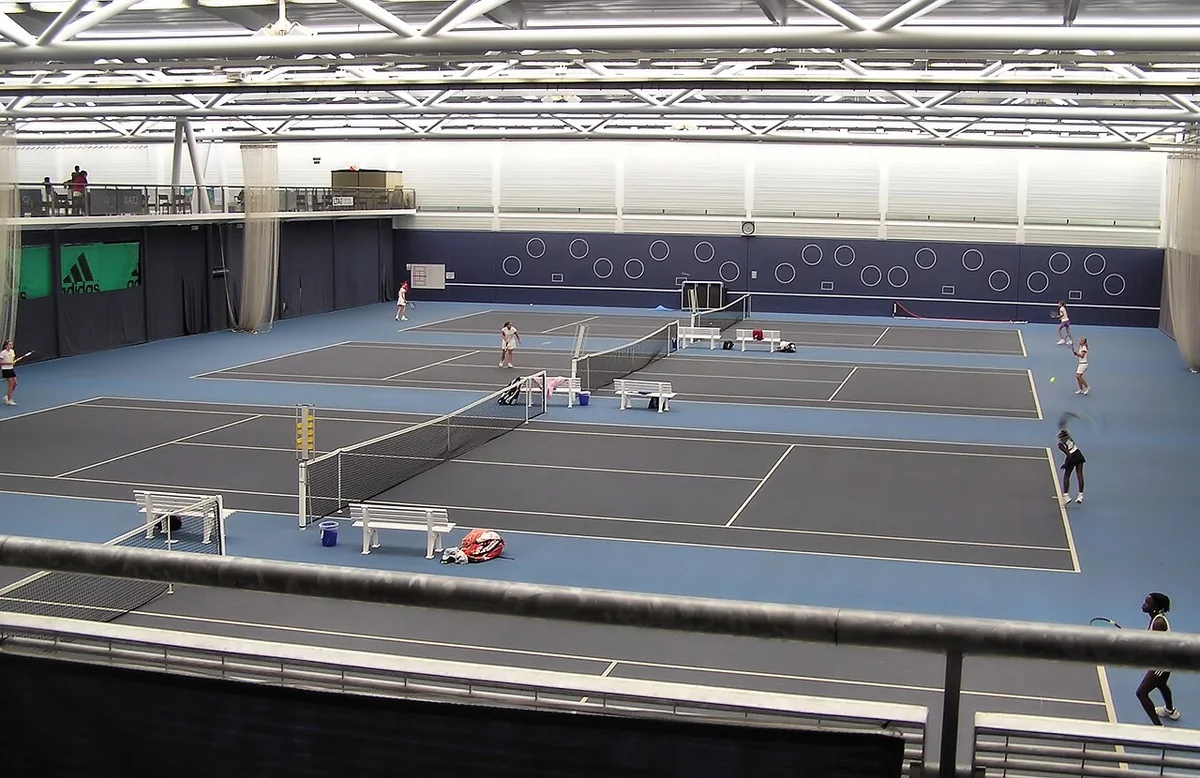
Four players meeting once each need six singles matches. Each player faces three opponents, giving twelve player appearances; divide by two players per match and the total is six. An ATP Finals group uses that same four-player structure. For a club gathering, it means that someone who loses the opening match still has two different opponents to play.
Running it on one court requires decisions about match length, rest and the ranking procedure. Six professional best-of-three singles matches demand a different booking from many club sessions. The worked example here uses a separately agreed one-set club format. Actual ATP Finals singles remains best of three tiebreak sets, including the final; the shorter format belongs to this practical adaptation.
Match the appearances to the available court time
Label the players A, B, C and D. The pairings are AB, AC, AD, BC, BD and CD. Fix that complete list before deciding how long each contest will be. With one-set matches, use the same game and set rules for everyone. If the booking proves too short, plan a shorter format or a longer booking next time. Keeping a common format throughout makes every result comparable.
| Match | Pairing |
|---|---|
| 1 | A – B |
| 2 | C – D |
| 3 | A – C |
| 4 | B – D |
| 5 | A – D |
| 6 | B – C |
This order covers every pairing once, while rest intervals differ. A plays matches one, three and five; D plays matches four and five consecutively. Different match lengths also mean that an equal number of matches waiting produces different minutes of rest. Agree a minimum rest period beforehand, and rotate the letter assignments at the next gathering so the same person is not always given the later back-to-back matches.
A court booking must also contain warm-up, changeovers between matches and rest. Use previous session durations to leave a practical margin rather than promising an exact finish from an invented average. Check remaining time against remaining matches during the session. That makes it easier to avoid leaving the final pair with all the pressure to hurry.
Record matches, sets and games together
The ATP Finals group procedure first compares wins, then matches played. If only two players are tied, their head-to-head result follows. For three tied players, the rules proceed through set percentage, game percentage and the specified ranking reference. The official examples put a 2–1 match record above 2–0 because more matches have been played at the same number of wins.
In a one-set club format, each match win is also one set won. Three players on 2–1 therefore all have a set percentage of 2/3. If the agreed procedure then uses game percentage, every final score is needed. Ask both players to confirm the score before leaving the court, rather than recording only the winner and trying to reconstruct games at the end of the session.
A worked example with three players on two wins
| Match | Score for the first player |
|---|---|
| A – B | 6–2 |
| B – C | 6–4 |
| C – A | 7–5 |
| A – D | 6–3 |
| B – D | 6–3 |
| C – D | 6–3 |
A beats B and D but loses to C. B beats C and D but loses to A. C beats A and D but loses to B. All three finish 2–1, with a circular head-to-head relationship. Selecting only A’s victory over B leaves C’s role unresolved, so the pre-agreed next criterion must be applied to the tied group.
| Player | Match record | Games won / all games | Game percentage |
|---|---|---|---|
| A | 2–1 | 17/29 | 58.62% |
| B | 2–1 | 14/27 | 51.85% |
| C | 2–1 | 17/31 | 54.84% |
| D | 0–3 | 9/27 | 33.33% |
A’s scores are 6–2 against B, 5–7 against C and 6–3 against D. That gives 17 games won and 12 lost: 17 out of 29, approximately 58.62%. B has 14 out of 27, approximately 51.85%, while C has 17 out of 31, approximately 54.84%. Applying game percentage to this example orders them A, C, B. The games within both wins and losses contribute to that calculation.
A and C both won 17 games, yet their percentages differ because A played 29 games and C played 31. Counting only games won would make them look equal. The denominator reveals the difference. Retain games lost as well as games won so another participant can reproduce the same calculation from the score sheet.
Compare the fractions before rounding, then use a consistent display precision such as two decimal places. Rounding different fractions too early can make close records appear equal. The value used to decide the position and the value displayed for easy reading therefore have separate jobs. Keeping the underlying games won and lost makes the arithmetic reviewable by all four participants.
Return to head-to-head when only two remain tied
The ATP procedure returns to the direct meeting if a three-way comparison separates one player while the other two remain tied. For example, one player may have a superior set percentage while the remaining pair have the same percentage. Those two use the winner of their own match to determine order. That differs from the worked table above, where all three game percentages are different.
Most club groups have no ATP ranking to use as a final criterion. Write down a suitable end point in advance: shared positions, for example, or a separately scheduled deciding match if there is enough time. For an injury or withdrawal, retain the actual score and mark the incomplete match. Agree how incomplete results will be treated before play, so no invented games or points are needed to make the table look complete.
- Before play: list the six pairings, match format, minimum rest, tie rules and treatment of incomplete matches on one sheet.
- After each match: both players confirm the score, then update matches, sets and games.
- At the end: compare wins and matches played first, then apply head-to-head or percentages according to the number tied.
- Next time: use the recorded durations and rest intervals to adjust the booking and rotate player letters.
At the ATP Finals, the top two from each of two groups advance to cross-group semifinals. A four-person gathering can finish after its six matches. If it adds a final, reserve the additional court time and rest from the outset. Deciding whether the purpose is to meet every opponent or also stage a final gives the same six-match record a clear role in the day.
Sources and further reading
Keep reading

Abandoned toss or missed swing: the rules for resetting a second serve
Catching an abandoned service toss is different from swinging and missing. Know the rule, keep the match moving, and practise the decision before a double fault makes it expensive.
7 min read
Tsitsipas’s first Dubai ATP 500: twelve finals and seven break points saved
A 6-3, 6-3 title on March 1, 2025: read the ATP 500 final record, Dubai history and a return game reversed from 40-0 together.
6 min readTENNIS TENSION LAB
Check your racquet’s tension today.
Get a high-precision tension reading in under 10 seconds. Tension Lab tracks changes from your first reading and helps you see when to restring.
- High-precision tension measurement. Ready in under 10 seconds.
- Track every change in feel. See the full story over time.
- Time to restring? Never leave it to guesswork.