Quentin Halys needed eleven attempts for a top-10 win. Dubai showed what changed.
A ranking rise starts before the headline victory: Challenger matches, qualifying rounds and another difficult service game after the first upset.
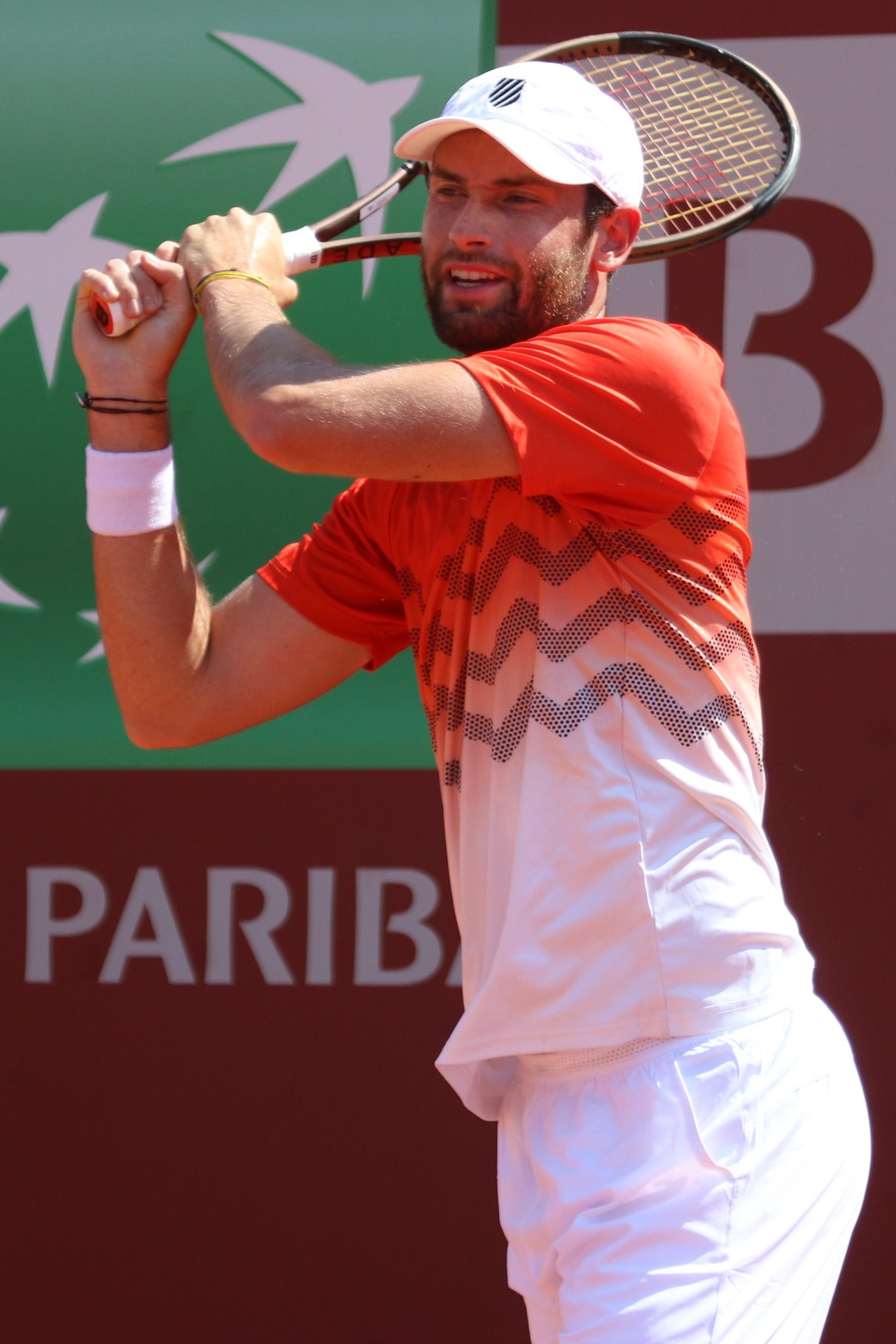
At 5–5 in the deciding set of his 2025 Dubai opener, Quentin Halys was serving at 0–40 against Andrey Rublev. The French qualifier saved those three break points and two more in the game, then won 3–6, 6–4, 7–6(5). It was his first victory over a top-10 opponent in eleven attempts, according to ATP’s career biography. The decisive achievement began before the tiebreak: he kept a difficult service game alive long enough to have that opportunity.
A first major upset can make a player look newly arrived. Halys was 28 and ranked No.77 in the tournament’s account of the February 25 match. He had already spent years winning at other professional levels and entering tour events through qualifying. Dubai is useful because it shows several separate tasks in one week: earn entry, survive a late crisis, and return the next day to face another established opponent.
The work accumulated on a different scale
ATP records his first ranking point in 2012, entry into the top 200 in 2015 and the top 100 in 2022. Those milestones belong beside his junior pedigree, which included a No.3 junior ranking. The seven calendar years between the latter two ranking milestones make the transition visible. A strong junior record brought an established competitive background; the professional ranking still had to be built across a different field and calendar.
In 2022, Halys went 43–10 on the Challenger circuit, winning titles in Pau, Lille and Ismaning. That is 43 wins in 53 matches at that level. The useful contrast is between a season of repeated results and a single famous opponent. A full record shows how frequently a player was returning to competition, while the trophy list identifies weeks in which he completed the job. Keep both when trying to understand a rise.
The next stage was also uneven in its entry routes. In 2024 he reached Wimbledon’s third round as a qualifier ranked No.220, then reached his first ATP Tour final in Gstaad from qualifying at No.192. A ranking beside a name tells you the published position at that moment; the rounds won show what happened within the event. Looking at entry route and finishing round together avoids missing a strong week by a player outside the main-draw cutoff.
Five break points inside one game
Rublev arrived in Dubai after winning Doha. He took the opening set, but Halys broke him twice in the second, including its final game. At 5–5 in the third, Rublev reached 0–40 on return. The tournament report records five break points saved in that game. That total extends beyond the initial three chances: Halys first escaped the three-point deficit and then had to keep solving the same service game after deuce.
The report identifies the score sequence and Halys’s emphasis on serving well and playing aggressively. It does not supply a shot-by-shot reconstruction of every saved chance. The concrete lesson is in the changing task: reaching deuce is one recovery, holding is another, and winning the later tiebreak is a third. Treating all three as a single moment of confidence would hide the decisions still required after each small recovery.

That win also opened Halys’s ATP 500 main-draw account. The opponent’s ranking and the tournament category describe two different barriers crossed in the same match. A viewer following a developing player can track those separately: first victory at an event level, first win against a ranking group, and first ability to repeat the result later in the week. One label rarely explains the entire breakthrough.
The next round asked a new question
Halys followed the Rublev victory by beating Roberto Bautista Agut, Dubai’s 2018 champion. The tournament’s second-round report places that result beside the first upset. The practical significance is simple: an outstanding win did not become the last entry in his week. He returned to play a different opponent and created another route into the quarterfinals, where the match would again require a recovery.
Luca Nardi led Halys by a set and a break in that quarterfinal. Halys won 2–6, 6–3, 7–6(5) in two hours and six minutes to reach his first ATP 500 semifinal. ATP’s February 27 report put him at No.58 in the live rankings at that moment. That live figure records the position during the event; it should stay attached to the report date when placed in a career timeline.
Nardi’s own route explains why an entry label is an incomplete scouting report. He had lost to Marton Fucsovics in qualifying, entered as a lucky loser after Jack Draper withdrew, then beat Fucsovics in the main draw and Zizou Bergs in the next round. Halys therefore faced someone who had already used a second opportunity well. Qualifier and lucky loser describe routes into the bracket, while the subsequent matches reveal the challenge waiting there.
| Period | Recorded result | Question it answers |
|---|---|---|
| 2022 | 43–10 in Challengers; three titles | Could he repeat results across a season? |
| 2024 Wimbledon / Gstaad | Qualifier to third round / qualifier to final | Could he extend a week after earning entry? |
| 2025 Dubai | First top-10 win; first ATP 500 semifinal | Could he recover and back up an upset? |
| 2026 Kitzbühel | First ATP Tour title without losing a set | Could he complete a tour-level title run? |
ATP’s biography, updated August 28, 2026, records a later first tour title in Kitzbühel without a set lost, including wins over then-No.19 Valentin Vacherot and No.11 Alexander Bublik. That later result completes another step. It does not turn every earlier defeat into a necessary recipe. The evidence supports a sequence of achievements at different levels, with Dubai supplying a particularly clear example of recovery within a match and repetition across a week.
Turn the sequence into a useful practice note
For club competition, choose one situation from the story instead of trying to imitate a professional’s entire game. Our suggested exercise begins a practice service game at 0–40. Record reaching deuce and completing the hold separately. On the next attempt, begin from a different score so that the exercise remains about deciding what the next point needs. The scores are a practice constraint, not a predicted success rate.
After a match, write the entry or preparation conditions, the difficult score, the action you actually chose and what followed. A note such as rushed second serve after saving a break point gives the next session a task. A note that only says mentally weak or confident offers much less to rehearse. Halys’s week is instructive because the record contains the game, the next opponent and the next recovery. Keep that level of detail in your own review.
Sources and further reading
Keep reading

Tsitsipas’s first Dubai ATP 500: twelve finals and seven break points saved
A 6-3, 6-3 title on March 1, 2025: read the ATP 500 final record, Dubai history and a return game reversed from 40-0 together.
6 min read
Arthur Gea’s 2026 breakthrough: from Australian Open upset to first ATP title
Arthur Gea’s 2026 path from Noumea to an Australian Open upset and a Los Cabos title reveals different steps behind one apparently sudden breakthrough.
8 min readTENNIS TENSION LAB
Check your racquet’s tension today.
Get a high-precision tension reading in under 10 seconds. Tension Lab tracks changes from your first reading and helps you see when to restring.
- High-precision tension measurement. Ready in under 10 seconds.
- Track every change in feel. See the full story over time.
- Time to restring? Never leave it to guesswork.