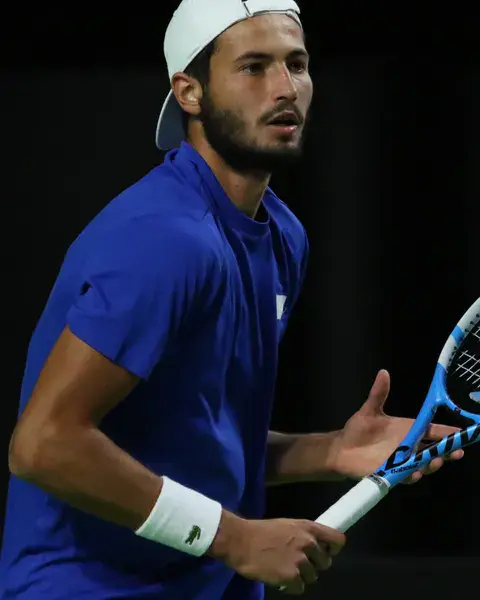
Titouan Droguet: 21 aces opened the door. A lob kept the next one open.
The qualifier label explains how he entered. It does not explain the problems he posed once he was there.

At 5–5 in the second-set tie-break, Titouan Droguet did not find the next point with an ace. He found it with a topspin lob. The ace came afterward, taking the Montpellier semi-final against Félix Auger-Aliassime into a deciding set. That two-point sequence is a better introduction to Droguet’s week than reducing it to a lower-ranked player serving unusually well.
He was serving extremely well. The previous day, Droguet had hit 21 aces and faced no break point while beating Tallon Griekspoor 7–6(5), 7–6(1). It was his first ATP Tour semi-final. But even a serve that removes the opponent’s return from many points leaves other jobs: finish a tie-break, recover after losing a set, and find another route when the opponent reaches the ball.
Qualifier tells you the route, not the standard
Droguet came through qualifying at the 2026 Open Occitanie, an ATP 250 in Montpellier. The Q beside his name described how he obtained a main-draw place. It was not a technical rating and did not make each subsequent win inexplicable. By Friday’s quarter-final he had already survived a demanding second-round match against the previous year’s finalist, Aleksandar Kovacevic.
That match ended 4–6, 7–6(5), 6–4. Read the middle set before jumping to the final one. A straight-sets exit was still possible until Droguet won the tie-break. He then had to begin another set rather than being awarded the match for having escaped. The comeback establishes a sequence of tasks he completed, without requiring an invented account of what he was thinking.
There were several qualifying success stories in Montpellier that week. Martin Damm also reached his first tour-level semi-final, while Arthur Gea reached the quarter-finals. A tournament can contain more competitive depth than the seed numbers suggest. This does not make qualifying the preferred route: it adds matches that must be won before the main draw. It does mean the draw notation should not substitute for watching the tennis.
Twenty-one aces still left two sets to finish
Against fourth seed Griekspoor, Droguet did not give away a single break-point opportunity. The Dutchman nevertheless took both sets to tie-breaks. Those facts fit together. Protecting your own service games does not automatically create separation on the return side; when neither player has secured the necessary gap, a set can contract into a short scoring sequence.
The quarter-final was therefore an impressive serving performance and a successful finish to two close sets. It should not be described as an effortless match just because Droguet was never down break point. Nor should the two tie-breaks imply that his serving advantage was imaginary. His service games created a dependable platform, and he still had to convert that platform into the set.
For club competition, it is worth tracking those two contributions separately. How often does your serve get you through the game without a major threat? Once the score reaches 5–5 or a tie-break, what patterns remain available? A player can improve the first area and still need experience in the second. Counting aces alone does not reveal whether the next playable return leaves you in a useful position.
Focus had a visible boundary
After the quarter-final, Droguet explained that he was not accustomed to such large courts. He tried to keep his attention on the court and his team rather than looking up at the surroundings. That is a specific description of how he managed an unfamiliar setting. It is more concrete than claiming he suddenly learned to ignore pressure.
The point is not that spectators should become invisible. In a home tournament, support is part of the occasion. The useful distinction is between appreciating it and repeatedly letting attention leave the task. An amateur in a final, with friends now watching, can decide in advance where to look between points and what simple information to return to: score, serving side and the next pattern. This is an editorial application of the observation, not a reported Droguet routine.

A practice score did not decide the semi-final
Before facing Auger-Aliassime, Droguet revealed that he had lost a practice set to the Canadian 6–0 the previous season. It made an irresistible preview detail. It did not make the next day’s result predetermined. Practice and tournament matches happen at particular times, under particular conditions, and a score alone does not describe every purpose of the session.
In the official match, Droguet lost the opening set 6–4, then took the second 7–6(5). At 5–5 in that tie-break he produced the topspin lob, followed by one of his 14 aces. The previous day’s big serve remained important, but this time a different shot created the chance to finish. Treating him only as a server would miss the point that immediately preceded the serve.
It is also a useful reminder for a player whose favourite pattern is widely known. You do not have to abandon your strongest shot to become less predictable. You need credible answers when a rally takes another shape. The source reports the lob and the ace; it does not establish a planned two-shot combination. The broader practice idea is to keep the alternative available, rather than assuming every crucial point must showcase the same weapon.
The deciding set contained a chance before the gap
Auger-Aliassime won the third set 6–1, but at 1–1 he first had to save two break points. Only afterward did he take the last five games. The final score can make the decider look as if it was never competitive. Its early sequence shows a point at which Droguet could still have moved ahead.
The Canadian gave a precise account of his adjustment: he felt he served better in the third set and improved his second-serve returns, striking the ball more cleanly to different targets. This is the winner’s explanation, not independent measurement of every return. It nevertheless offers a useful contrast with an ace count. Once the returner makes more of the deliveries that can be attacked, the server must repeatedly solve a different first rally ball.
Auger-Aliassime saved all three break points he faced in the match and converted three of ten chances. Droguet’s ability to extend the contest was real; the opponent’s ability to finish it was real too. There is no need to explain the result by deciding that the qualifier lacked courage. The report supplies competitive actions, an early third-set opportunity and the stronger player’s stated adjustments.
What to take into the next tie-break
Try a practice set in which you note only three things: the serve pattern used on important points, what happened when the return came back, and whether the next decision changed after a lost point. Keep the usual rules. Do not award bonus points for aces or lobs; that would encourage the spectacular shot rather than the appropriate one. Review the decisions after the set, when you can separate the outcome from the intention.
Give those notes one extra field: where the point ended. Was it the serve, the return or your first rally ball? Being pushed behind the baseline after second serves calls for a different exercise from missing returns outright. After the set, use the repeated situation to choose the next drill. That gives the next practice a specific task instead of treating every lost tie-break point as the same problem.
Droguet’s Montpellier run finished in the semi-finals, not with a trophy. It still introduced a player capable of recovering from a set down, protecting serve against a seeded opponent and forcing a top seed into a third set. The 21 aces earned attention. The lob, the tie-breaks and the opponent’s response show why the week deserves more than a single statistic.
Sources and further reading
Keep reading
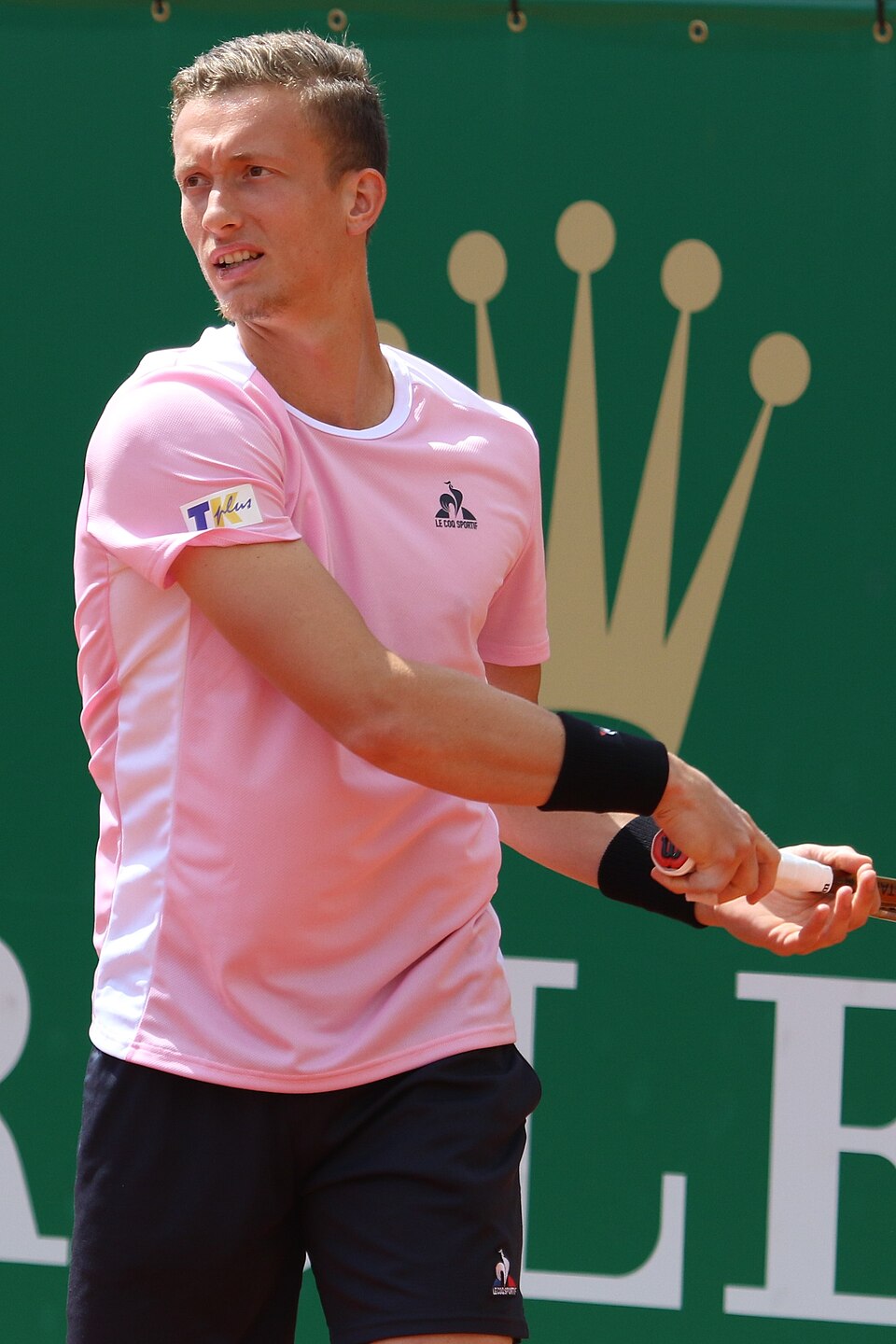
Lehecka held serve for five matches. Sinner broke him in his second service game.
Lehecka’s 2026 Miami run ended against Sinner, but the useful story lies in 11 break points, a missed 0–40 chance and the difference between holding and controlling.
8 min read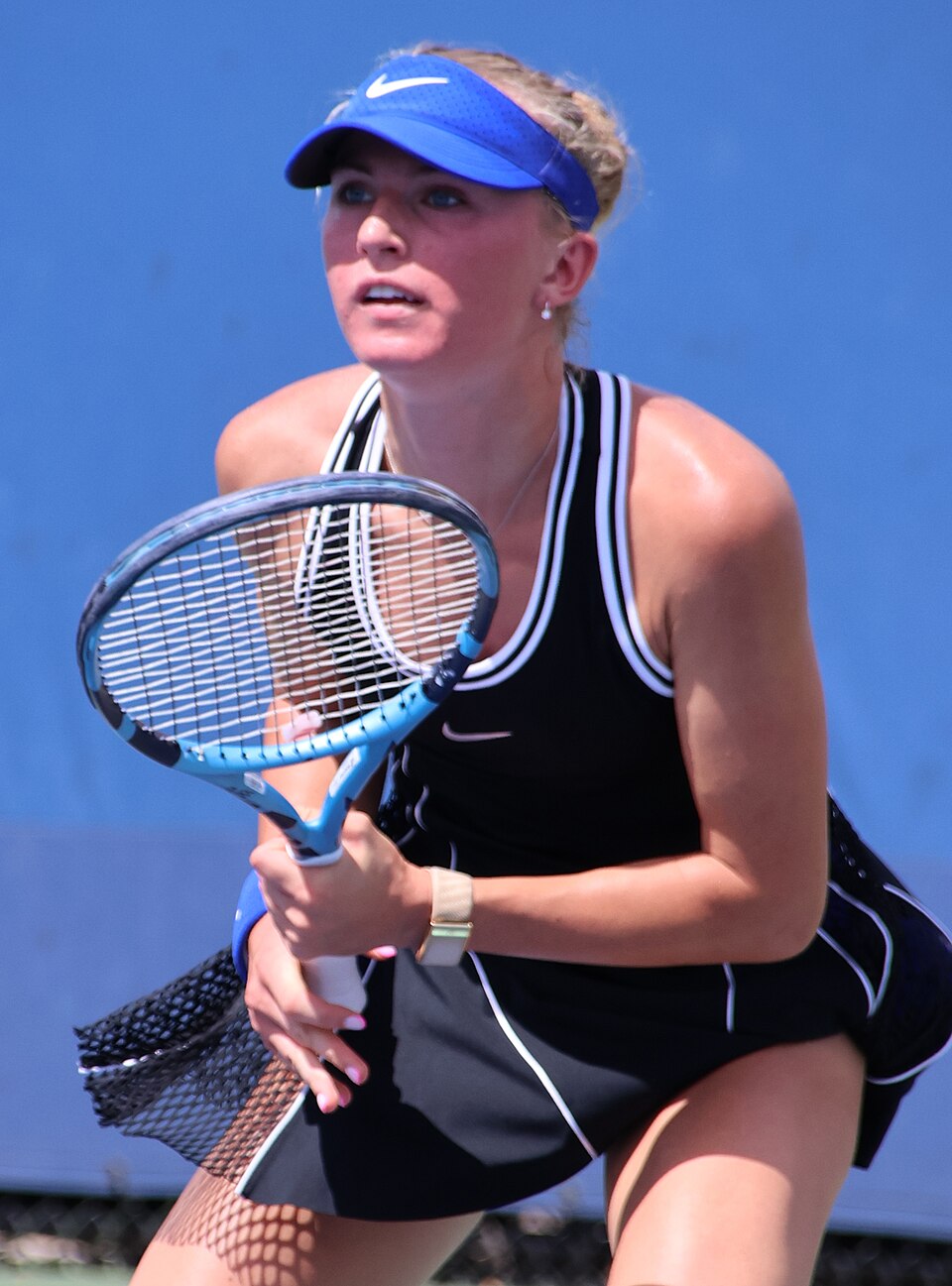
Laura Samson: from W15 wins to a WTA semifinal in one week
Before Prague 2024, Laura Samson had never won above ITF W15 level. Three victories, seven match points and a semifinal retirement tell the full story.
8 min read
Can a Wild Card Be Seeded? The Ranking Dates Behind WC
A player can enter on a wild card and still be seeded. Learn why Grand Slam entry and seeding use different ranking dates, with a practical draw-reading guide.
8 min readTENNIS TENSION LAB
Check your racquet’s tension today.
Get a high-precision tension reading in under 10 seconds. Tension Lab tracks changes from your first reading and helps you see when to restring.
- High-precision tension measurement. Ready in under 10 seconds.
- Track every change in feel. See the full story over time.
- Time to restring? Never leave it to guesswork.