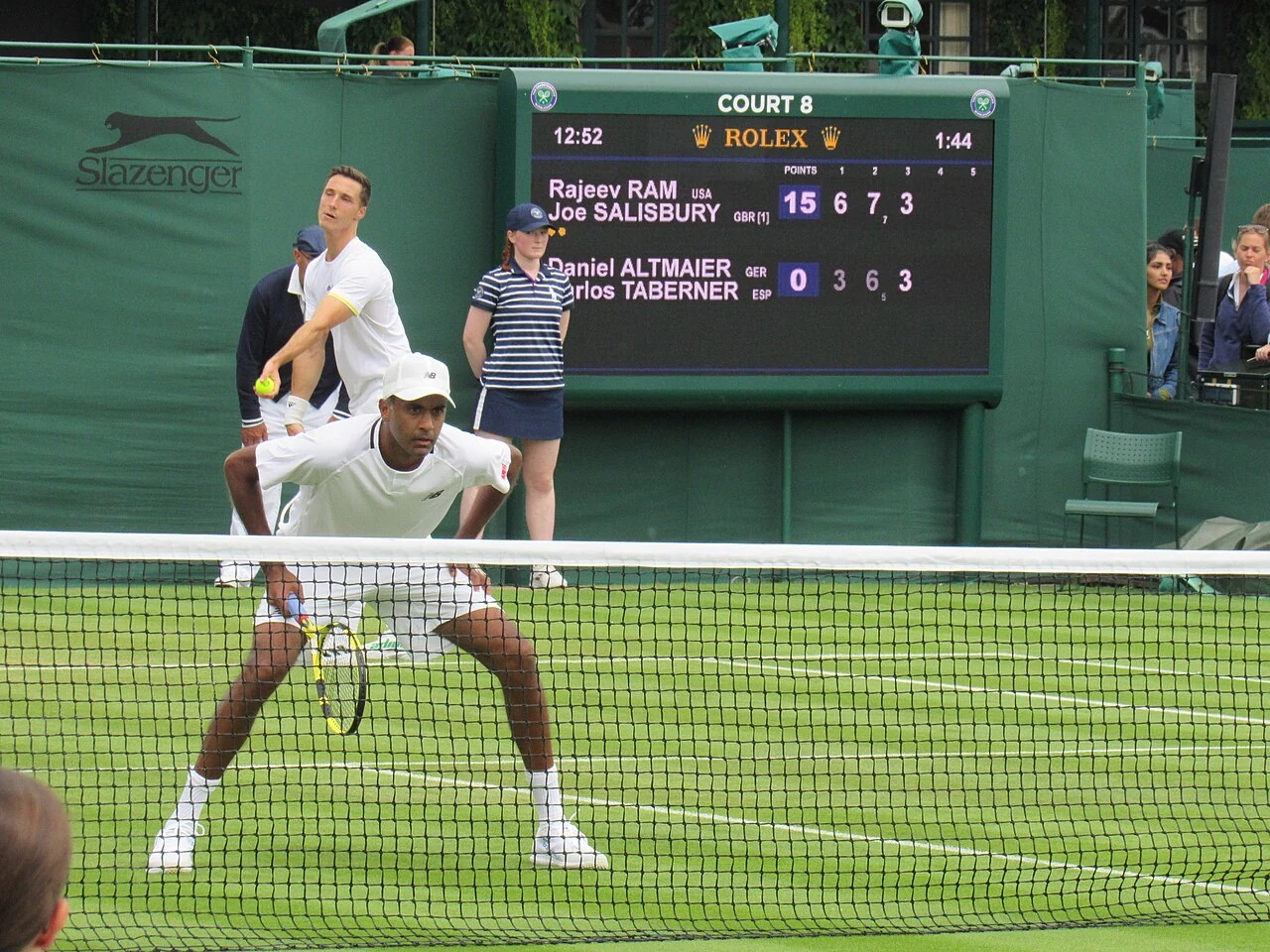
In doubles, one player serves the whole service game, and the four-player service order repeats throughout the set. Deuce- and ad-court receiving assignments also stay fixed. USTA’s doubles guide allows both choices to change at the start of a new set. These are separate from changing court ends between games.
If your player A serves game one and opponent C serves game two, your partner B serves game three and opponent D game four. A returns for game five: A-C-B-D repeats. A difficult service game stays with its server, and the next team service game belongs to the partner in that sequence.
For receiving, choose who takes the first, deuce-court serve in the team’s first receiving game. The partner takes the ad court. If A chooses deuce and B ad, they keep those assignments at later receiving games in that set, including after a change of ends or a different opposing server.
Once the return is played, either partner may hit subsequent shots, without alternating. A can return and play the next ball, or B can cross to volley. Receiving sides organise the service reception; during the rally the partners cover space according to the ball and each other.
At the next set, the team can choose B as its first server and can also choose B as the deuce-court receiver. Confirm each decision separately. Naming the server leaves the receiving assignments to be settled in their own right. A brief spoken check avoids confusion in the following games.
A serve hitting a partner also depends on which team is struck. USTA calls a fault if it hits the server’s partner, but awards the server the point if it hits either receiver before bouncing. The server’s partner should stay clear of the serve path, while the receiving pair prepares to judge the bounce rather than catch an incoming serve.
For a club match, say the four-server sequence aloud at the start of the set, then identify each team’s deuce receiver. Track completed games to find the next server and retain the receiving sides. Re-establish these assignments when moving from frequently rotated practice into normal games.